A house is a structure; a home is an experience. The vocabulary for describing houses and homes must do double work — capturing the physical reality of a building while conveying the emotional and atmospheric qualities that make a space feel inhabited, welcoming, or its opposite. Whether you are writing real estate copy, fiction, interior design content, or travel writing, this guide gives you 90 adjectives for houses and homes, organized by style, condition, atmosphere, and feeling.
Words for Welcoming, Comfortable Homes
- Cozy — warm and comfortable; small enough to feel embracing. “A cozy cottage with low ceilings and a fire that understood its job.”
- Inviting — makes you want to come in; warm and appealing from the threshold. “An inviting front door that suggested the rest of the house would be worth it.”
- Welcoming — creates immediate comfort for guests; feels inclusive. “A welcoming kitchen that smelled of something worth staying for.”
- Homely — warm and unpretentious; feels like a real home rather than a showpiece. “Homely in the best sense — nothing performative, everything lived in.”
- Snug — small and warm; pleasantly compact and sheltered. “A snug reading room at the back of the house that no one else needed to know about.”
- Warm — emotionally and physically warm; good light, soft surfaces. “Warm in a way that had nothing to do with the heating system.”
- Lived-in — shows evidence of real life; comfortable rather than pristine. “Lived-in in the way that meant bookshelves with bent spines and kitchen walls with stains that told stories.”
- Intimate — small-scale and personal; not grand or formal. “An intimate dining room that made every dinner feel like a confession.”
Words for Grand and Impressive Homes
- Stately — grand and imposing in a dignified way; formal architecture. “A stately Georgian house that expected to be approached with respect.”
- Palatial — on the scale of a palace; large, grand, and luxurious. “Palatial in the way of houses that have more rooms than purposes.”
- Imposing — large and commanding; slightly intimidating. “An imposing Victorian terrace that dominated the street.”
- Elegant — graceful and refined; well-proportioned and carefully finished. “An elegant Regency interior — every detail right, nothing excessive.”
- Handsome — attractive in a solid, well-proportioned way. “A handsome red-brick house that had been improved by every decade it had survived.”
- Sprawling — extends over a large area; added to over generations. “A sprawling farmhouse that had been extended in every era and showed it.”
- Magnificent — impressively beautiful on a grand scale. “A magnificent drawing room that had hosted a century of significant conversations.”
Words for Atmosphere and Character
- Atmospheric — has a strong distinctive mood; history is present. “Atmospheric in the way of old houses that have absorbed the people who lived in them.”
- Characterful — has distinctive, interesting features; not generic. “Characterful in the way of houses that were never designed to be identical.”
- Historic — carries visible evidence of age and history. “Historic timber-framed house that had been standing since the Civil War.”
- Quirky — has unexpected and interesting individual features. “A quirky cottage with unexpected alcoves and a staircase that went somewhere unplanned.”
- Rambling — extends in an irregular way; rooms added as needed over time. “A rambling old rectory with more corridors than any architect planned.”
- Mysterious — suggests hidden things; rooms not yet discovered. “Mysterious in the way of large old houses with wings nobody used.”
Words for Poor Condition
- Dilapidated — in advanced disrepair; falling apart through neglect. “Dilapidated in a way that required either significant money or significant imagination.”
- Neglected — not maintained; showing the results of inattention. “Neglected garden and peeling paint — the house had been waiting for someone to care.”
- Crumbling — literally falling apart; structural deterioration. “Crumbling plaster and rotten window frames — a survey that ran to twelve pages.”
- Run-down — in poor condition through use or age. “Run-down but in a neighborhood where that was about to change.”
- Derelict — abandoned and in extreme disrepair. “Derelict for fifteen years — the garden had made its own decisions.”
Frequently Asked Questions
What are the best adjectives to describe a house?
For welcoming homes: cozy, inviting, homely, snug, and warm. For impressive homes: stately, palatial, elegant, and handsome. For atmospheric homes: characterful, rambling, historic, and quirky. For condition: dilapidated, neglected, pristine, or immaculate. The most effective house descriptions combine structural vocabulary (Georgian, Victorian, timber-framed) with atmospheric vocabulary (cozy, stately, atmospheric) and a single specific physical detail that makes the house unique.
What words describe a luxury home?
Luxury home vocabulary: palatial (palace-scale), opulent (rich and lavish), sumptuous (luxuriously furnished), immaculate (perfectly maintained), bespoke (custom-made to specification), expansive (large and open), and prestigious (carries social status). Real estate luxury vocabulary also includes: prime location, statement architecture, resort-style, and curated (every element deliberately chosen).
How do you describe a cozy home?
Cozy home vocabulary: snug, warm, inviting, intimate, welcoming, homely, toasty, and comfortable. The most evocative cozy descriptions go beyond adjectives to specific sensory details: the smell of baking, the sound of a fire, the texture of a worn sofa, the quality of light through a particular window. Cozy is fundamentally a sensory experience — describe what the senses encounter, not just the space.
What words describe an old or historic house?
Historic house vocabulary: ancient (very old), storied (rich with history), time-worn (showing the marks of centuries), atmospheric (mood generated by history), rambling (grown organically over time), character-filled, and venerable (commanding respect through age). For specific styles: Georgian (1714-1830), Victorian (1837-1901), Edwardian (1901-1910), Arts and Crafts, and Art Deco each have their own specific vocabulary.
How do writers describe houses in fiction?
In fiction, houses reveal character — both the character of the inhabitants and the character of the story. Wuthering Heights is the building; Manderley in Rebecca is as much a character as Mrs. Danvers. The most effective fictional house descriptions use the building to externalize psychological states: the crumbling house for the declining family, the cold house for the cold marriage, the labyrinthine house for the confused or trapped protagonist. Always ask: what does this house say about the people inside it?
What are some descriptive words for Home ?
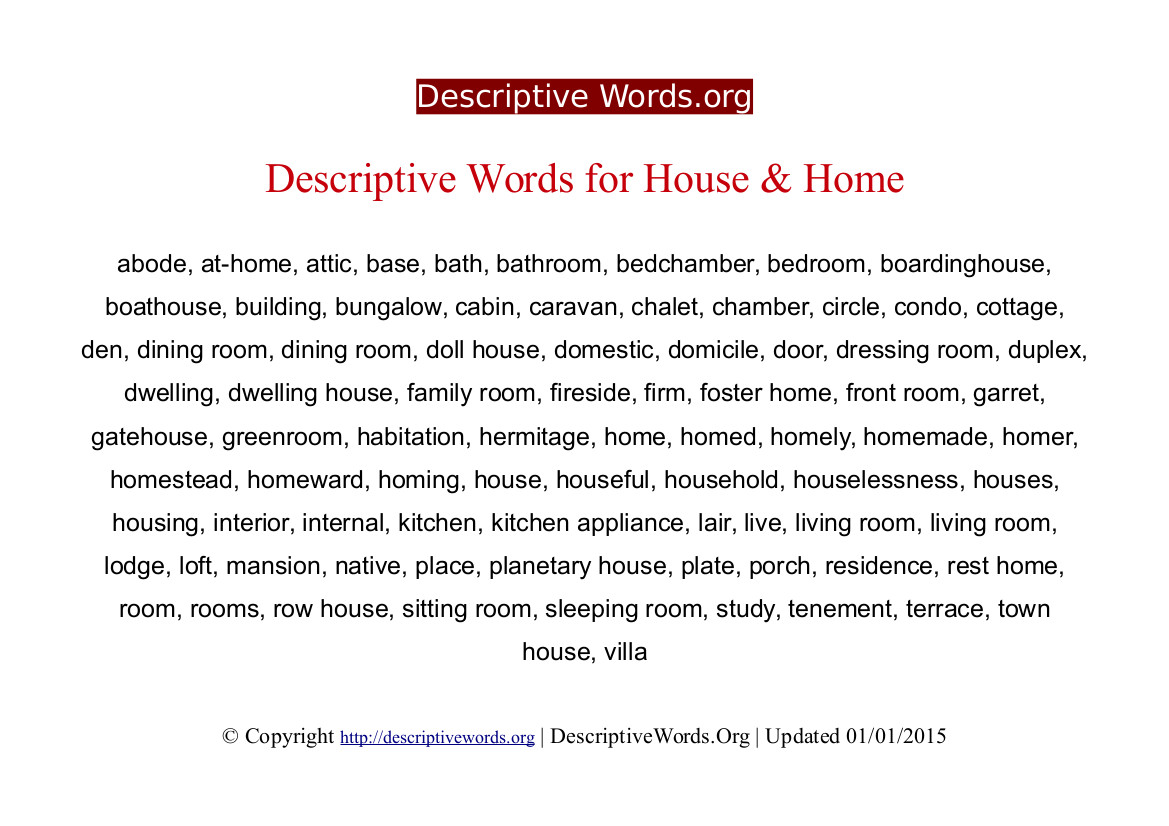
Here is a list of words that describe Home.
Total number of Home words and adjectives: Home 82 words
Home words are listed in alphabetical order.
athome,
attic,
base,
bath,
bathroom,
bedchamber,
bedroom,
boardinghouse,
boathouse,
building,
bungalow,
cabin,
caravan,
chalet,
chamber,
circle,
condo,
cottage,
den,
dining room,
diningroom,
dollhouse,
domestic,
domicile,
door,
dressing room,
duplex,
dwelling,
dwelling house,
family room,
fireside,
firm,
foster home,
front room,
garret,
gatehouse,
greenroom,
habitation,
hermitage,
home,
homed,
homely,
homemade,
homer,
homestead,
homeward,
homing,
house,
houseful,
household,
houselessness,
houses,
housing,
interior,
internal,
kitchen,
kitchen appliance,
lair,
live,
living room,
livingroom,
lodge,
loft,
mansion,
native,
place,
planetary house,
plate,
porch,
residence,
rest home,
room, rooms,
row house,
sitting room,
sleeping room,
study,
tenement,
terrace,
town house,
villa.
Download Home Words PDF: Descriptive Words for Home PDF