Wind is one of the most challenging natural phenomena to describe because it has no visible form — it exists only through its effects on other things. The English language has developed a rich vocabulary for wind that ranges from the gentlest breath to the most destructive force, from the refreshing to the malevolent. Whether you are writing poetry, fiction, travel writing, or nature essays, this guide gives you 74 adjectives to describe wind, organized by strength, quality, temperature, and emotional character, with definitions and example sentences.
Words for Wind Strength
- Gentle — barely felt; the softest possible movement of air. “A gentle breeze that did nothing more than lift the edge of the cloth.”
- Light — easily felt but mild; pleasant and non-disruptive. “A light breeze that made the heat just bearable.”
- Moderate — clearly felt; moves leaves and small branches. “A moderate wind that kept the flags horizontal.”
- Strong — requires effort to walk against; moves large branches. “A strong wind that made conversation difficult outside.”
- Brisk — energetically cold and fresh; invigorating. “A brisk sea wind that woke everyone up.”
- Blustery — gusty and variable; strong in bursts rather than steady. “A blustery day that sent leaves spiraling at unpredictable intervals.”
- Gusting — sudden, strong bursts separated by relative calm. “Gusting to 60 miles per hour with no warning.”
- Howling — strong enough to produce a continuous wailing sound. “Howling wind that made the old house creak and moan.”
- Roaring — very strong; makes a continuous deep sound. “A roaring gale that drowned everything except itself.”
- Ferocious — violently powerful; causing damage. “Ferocious gusts that brought down trees and power lines.”
- Furious — intensely violent; the wind at its most aggressive. “A furious storm wind that made the sea indistinguishable from the sky.”
- Tempestuous — wild and stormy; associated with turbulent weather. “Tempestuous conditions that closed the mountain pass.”
Words for Wind Temperature and Quality
- Warm — carries heat; can be pleasant or uncomfortable depending on context. “A warm breeze off the desert that offered no relief.”
- Hot — above body temperature; distinctly uncomfortable. “A hot desert wind that dried the mouth in minutes.”
- Scorching — hot enough to damage; wind as a weapon. “Scorching sirocco wind from North Africa.”
- Cool — pleasantly below body temperature; refreshing. “A cool breeze off the sea at exactly the right moment.”
- Cold — noticeably below comfortable; requires a layer. “A cold northerly wind that arrived without warning.”
- Icy — very cold; penetrating and immediately felt. “An icy wind off the glacier that cut through every layer.”
- Arctic — extreme cold; wind from polar regions. “An Arctic blast that dropped the apparent temperature by twenty degrees.”
- Bitter — cold and hostile in quality; feels personal in its coldness. “A bitter easterly wind that found every gap in every collar.”
- Dry — carries no moisture; dehydrating. “A dry wind off the Sahara that cracked skin within hours.”
- Salt-laden — carries sea salt; the specific quality of coastal wind. “A salt-laden sea wind that left a white residue on every surface.”
- Fragrant — carries pleasant scent; spring or floral breezes. “A fragrant wind from the jasmine fields below.”
- Fresh — clean, cool, and invigorating. “A fresh wind off the sea that made everything smell possible.”
Words for Wind Sound and Movement
- Whispering — the softest audible wind; murmurs through leaves. “Whispering through the long grass in a language that needed no translation.”
- Sighing — a gentle, mournful sound; the wind as an expression of emotion. “Sighing through the eaves of the old house.”
- Rustling — moving dry leaves or paper; a specific sound of gentle wind. “Rustling the pages of the book she had been unable to put down.”
- Moaning — a low, mournful sound; associated with strong wind through structures. “Moaning around the corners of the building all night.”
- Keening — a high, sustained, sorrowful sound. “Keening across the open moor — a sound like grief given form.”
- Shrieking — very high and sharp; storm-force wind through narrow gaps. “Shrieking through the rigging in a way that made sleep impossible.”
- Swirling — moving in circular patterns; eddying. “Swirling dust that rose and fell without apparent purpose.”
- Fitful — irregular and changeable; starts and stops without pattern. “A fitful breeze that made the sailing frustrating.”
Words for Wind Mood and Character
- Capricious — unpredictable and changeable; does what it pleases. “Capricious spring wind that shifted direction every ten minutes.”
- Relentless — does not stop or pause; continuous and wearing. “Relentless wind that ground down the enthusiasm of even the most determined walkers.”
- Playful — light and unpredictable in a pleasant way. “A playful breeze that lifted hats and turned umbrellas inside out.”
- Malevolent — seems actively hostile; used in literary/personified description. “A malevolent wind that tore the tiles and cracked the windows.”
- Incessant — never ceases; the most wearing quality of wind in exposed places. “Incessant Patagonian wind that was simply part of the landscape.”
- Lashing — strikes repeatedly; wind driving rain against surfaces. “Lashing rain and wind that made the crossing more memorable than planned.”
Frequently Asked Questions
What are the best adjectives to describe wind?
For gentle wind: whispering, sighing, gentle, and rustling. For strong wind: howling, roaring, gusting, blustery, and ferocious. For cold wind: bitter, icy, Arctic, and piercing. For warm wind: scorching, balmy, and fragrant. The most vivid wind descriptions combine strength with temperature and sound: ‘a bitter, howling northerly’ or ‘a fragrant, sighing summer breeze.’
What are the names of famous winds?
Famous named winds: the Sirocco (hot North African wind reaching southern Europe), the Mistral (cold northerly wind of southern France), the Föhn (warm dry Alpine wind), the Harmattan (dry West African wind), the Bora (cold Adriatic wind), the Santa Ana (hot, dry California wind), and the Chinook (warm Rocky Mountain wind). Each has its own adjectives: the Sirocco is scorching and sand-laden; the Mistral is fierce and relentless.
How do poets describe wind?
Poets personify wind more than any other natural element: Shelley’s ‘Wild West Wind’ is ‘destroyer and preserver,’ ‘tameless and swift and proud.’ Hopkins describes wind as ‘the achieve of, the mastery of the thing.’ The key poetic technique is personification — giving the wind intention, emotion, and character — combined with specific sensory vocabulary for sound and physical effect.
What words describe wind in winter?
Winter wind: bitter (hostile and cold), biting (painful on exposed skin), piercing (cuts through clothing), icy, howling (through bare branches), relentless (never stopping), and numbing. ‘Biting’ is particularly specific — it implies the wind as predator, attacking exposed flesh. ‘Bitter’ adds an emotional quality: the wind as personally hostile.
How do you describe a gentle breeze?
A gentle breeze: whispering, sighing, balmy (warm and gentle), refreshing, caressing (soft and pleasant on skin), rustling (moving leaves softly), and fitful (gentle and intermittent). The key technique: describe the breeze through its effect on other things — ‘a breeze that did nothing more than lift the edge of the page’ creates a precise and gentle image without requiring a strong adjective.
What are descriptive words for Wind?
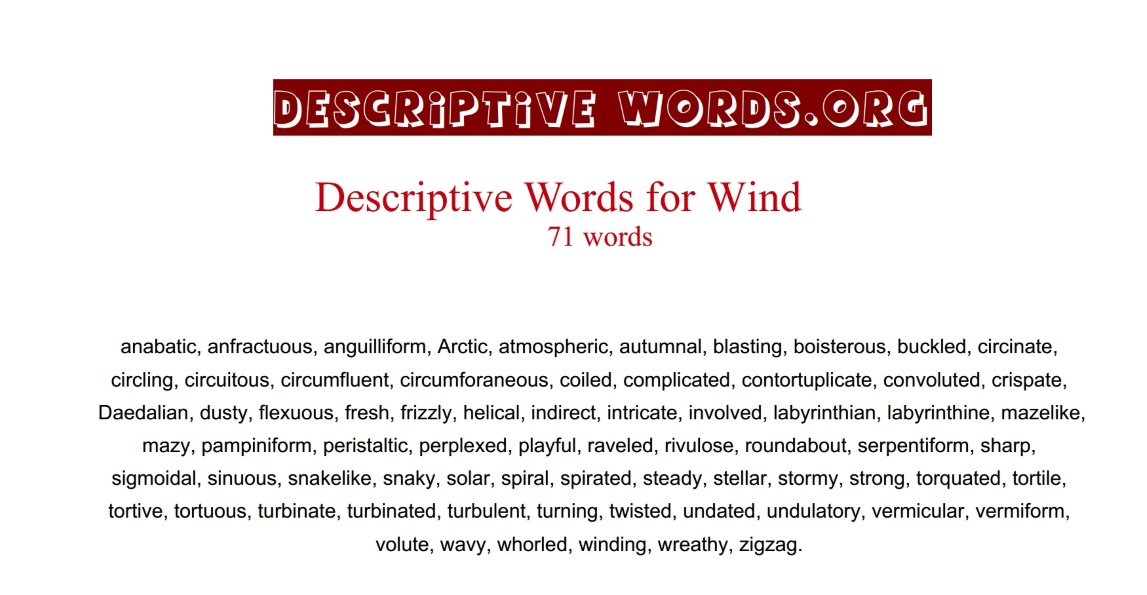
Here is a list of words that describe Wind:
- anabatic
- anfractuous
- anguilliform
- Arctic
- atmospheric
- autumnal
- blasting
- boisterous
- buckled
- circinate
- circling
- circuitous
- circumfluent
- circumforaneous
- coiled
- complicated
- contortuplicate
- convoluted
- crispate
- Daedalian
- dusty
- flexuous
- fresh
- frizzly
- helical
- indirect
- intricate
- involved
- labyrinthian
- labyrinthine
- mazelike
- mazy
- pampiniform
- peristaltic
- perplexed
- playful
- raveled
- rivulose
- roundabout
- serpentiform
- sharp
- sigmoidal
- sinuous
- snakelike
- snaky
- solar
- spiral
- spirated
- steady
- stellar
- stormy
- strong
- torquated
- tortile
- tortive
- tortuous
- turbinate
- turbinated
- turbulent
- turning
- twisted
- undated
- undulatory
- vermicular
- vermiform
- volute
- wavy
- whorled
- winding
- wreathy
- zigzag
Wind words are listed in alphabetical order.
Total number of Wind words and adjectives: 71 words
Download Wind Words PDF: Descriptive Words for Wind PDF