Luck is one of the most philosophically and practically interesting concepts in the English language — the vocabulary for luck spans from the purely positive (fortunate, blessed, charmed) to the ambiguous (serendipitous, coincidental) to the negative (unfortunate, ill-fated). A precise luck vocabulary allows writers, speakers, and thinkers to distinguish between genuine chance, manufactured opportunity, and the various superstitions and cultural beliefs that surround fortune. This guide gives you 70 adjectives for luck and fortune, with definitions and example sentences.
Words for Good Luck and Fortune
- Lucky — having or brought by good luck. “Lucky in the way of people who create the conditions for things to go well.”
- Fortunate — having good fortune; favored by circumstances. “Fortunate in timing — the deal closed a week before the market moved.”
- Blessed — endowed with divine favor; having exceptional good fortune. “Blessed with the specific luck of being in the right place when the right thing happened.”
- Charmed — having a life that seems magically protected from bad fortune. “Charmed existence that attracted attention in proportion to how little he sought it.”
- Auspicious — suggesting good fortune to come; favorable. “Auspicious beginning that the team took as evidence the project was meant to succeed.”
- Propitious — giving or indicating a good chance of success; favorable. “Propitious moment to launch — the market was ready before anyone had told it so.”
- Serendipitous — occurring by a fortunate accident; good luck by chance discovery. “Serendipitous meeting that led to a partnership neither had planned for.”
- Providential — occurring at a favorable time as if by divine arrangement. “Providential intervention — the delay that felt like bad luck proved to be the opposite.”
Words for Bad Luck and Misfortune
- Unlucky — having bad luck; things tend to go wrong. “Unlucky in small ways that accumulated into a pattern he had learned not to ignore.”
- Unfortunate — having bad luck; the gentler term for misfortune. “Unfortunate timing — the announcement landed on the worst possible day.”
- Ill-fated — destined to fail or meet disaster. “Ill-fated expedition that the weather had decided against before it began.”
- Hapless — persistently unlucky; chronically unfortunate. “Hapless in the way of characters who attract disaster without seeking it.”
- Jinxed — believed to be under a curse; seems to bring bad luck. “Jinxed project that changed managers three times before anyone admitted the real problem.”
- Cursed — believed to be affected by a curse; persistently unfortunate. “Cursed in the specific way of ventures that go wrong in new and creative ways each time.”
- Star-crossed — thwarted by bad luck; especially in love. “Star-crossed in the original sense — their timing was never right.”
- Luckless — having no luck; fortune consistently absent. “Luckless in his attempts — not for want of trying.”
Words for Chance and Coincidence
- Coincidental — occurring by chance; not planned or connected. “Coincidental in a way that strained the definition of coincidence.”
- Accidental — happening by accident; not intended. “Accidental discovery that was more valuable than the thing being sought.”
- Fortuitous — happening by chance; often with a positive implication. “Fortuitous delay that put him in the right place at the right time.”
- Random — without pattern or predictability; governed by chance alone. “Random in a way that made predictions useless and preparation essential.”
- Unexpected — not anticipated; arriving without warning. “Unexpected windfall that required an entirely new category of decision-making.”
Frequently Asked Questions
What are the best adjectives to describe luck?
For good luck: lucky, fortunate, blessed, charmed, auspicious, serendipitous, and propitious. For bad luck: unlucky, unfortunate, ill-fated, hapless, star-crossed, and luckless. For chance: fortuitous, coincidental, accidental, and serendipitous. The most precise good-luck adjective is ‘auspicious’ — it describes not just luck itself but a favorable sign or beginning that suggests luck to come.
What are literary or poetic words for luck and fortune?
‘Fortuitous’ (happening by chance, often favorably), ‘serendipitous’ (discovering good things by accident — coined by Horace Walpole from the Persian fairy tale ‘Three Princes of Serendip’), ‘propitious’ (giving a good chance of success), ‘auspicious’ (suggesting future success — from the Roman practice of reading omens in bird behavior, ‘auspex’), and ‘kismet’ (Turkish/Arabic: fate, destiny) are elevated luck vocabulary. ‘Serendipity’ has one of the most interesting etymologies in English — it comes from ‘Serendip,’ the old Arabic name for Sri Lanka.
What words describe someone who is very lucky?
Very lucky person vocabulary: charmed (seems to have magical protection), blessed (has exceptional good fortune, perhaps divinely given), favored (circumstances consistently work in their favor), fortunate (luck is consistently on their side), golden (everything goes right), silver-spooned (born into luck), and jammy (British informal: luckily successful). The philosophical debate behind these words: is ‘lucky’ a stable personal quality, or does it describe a pattern that could change at any time?
What is the difference between lucky, fortunate, and blessed?
‘Lucky’ is the most casual and general — good outcomes that could have gone otherwise. ‘Fortunate’ is more formal and implies a greater scale of good outcome — it often appears in contexts where luck has significantly affected a life course. ‘Blessed’ adds a dimension of gratitude and often of divine or supernatural favor — it implies the luck came from somewhere meaningful, not merely from chance. The progression: lucky (casual good outcome) — fortunate (significant good outcome) — blessed (meaningful good outcome, possibly from a higher source).
How do writers use luck and chance in fiction?
Luck in fiction must be handled carefully — readers accept bad luck more readily than good luck. A coincidence that helps the protagonist is often called ‘convenient’; the same coincidence harming them is ‘dramatic irony.’ The rule: good luck should be earned (the protagonist’s previous choices created the conditions) or rare (one piece of fortune in a story of difficulty). Bad luck can arrive freely — it feels true to life. The luckiest characters in fiction are usually those who create the conditions for luck to find them.
What Are Some Adjectives/Descriptive Words For Luck?
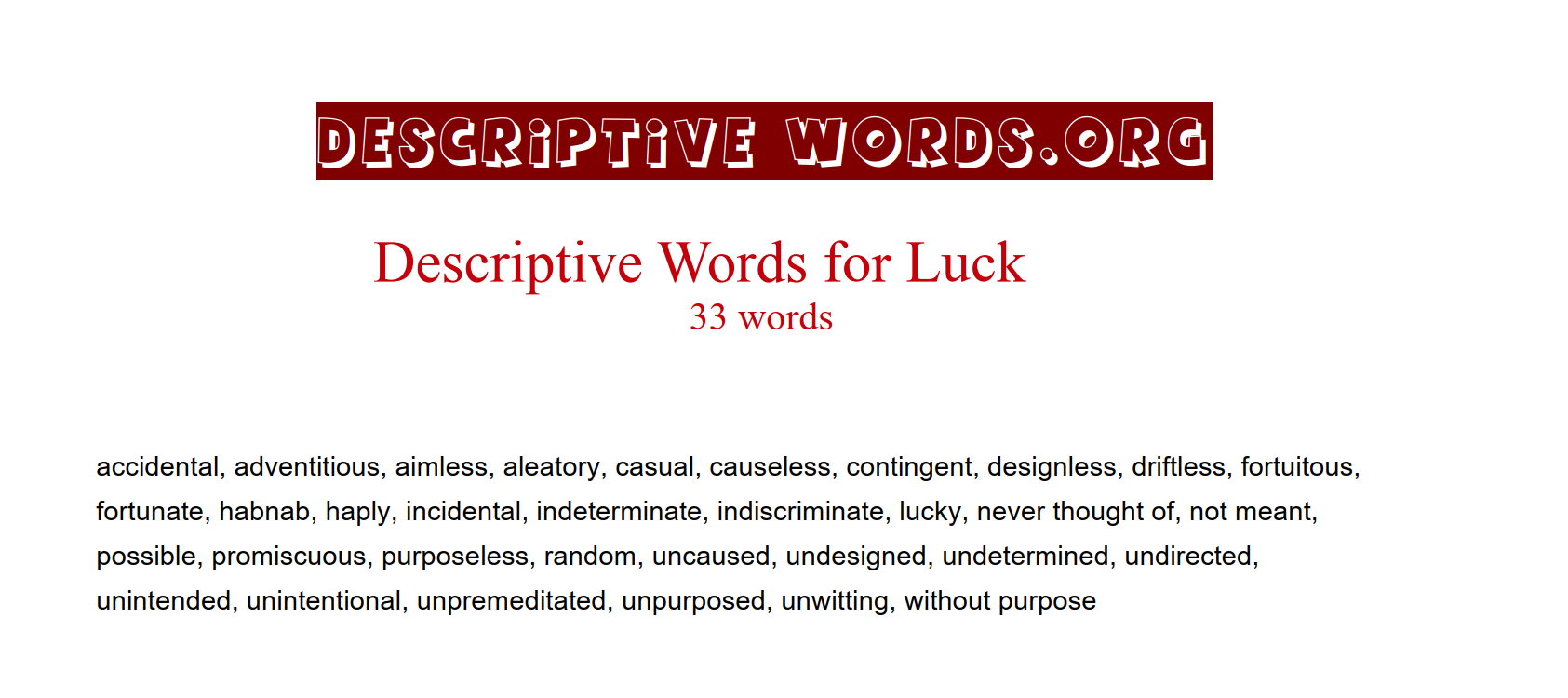
Here is a list of Descriptive Words for Luck.
If you know more adjectives or descriptive/describing words for Luck than let us know and we will add them to the list.
Total adjectives for the word Luck: 33 words
Words are listed in alphabetical order.
accidental
adventitious
aimless
aleatory
casual
causeless
contingent
designless
driftless
fortuitous
fortunate
habnab
haply
incidental
indeterminate
indiscriminate
lucky
never thought of
not meant
possible
promiscuous
purposeless
random
uncaused
undesigned
undetermined
undirected
unintended
unintentional
unpremeditated
unpurposed
unwitting
without purpose
Download Luck Adjectives/Descriptive Words PDF: Descriptive Words for Luck PDF