Happiness is one of the most written-about and least precisely described human experiences. The English language distinguishes far more varieties of positive emotional state than most people use — from the quiet contentment of a satisfying afternoon to the overwhelming joy of a life-changing moment. This guide gives you 78 adjectives to describe happiness and positive emotions, organized by intensity and type, with definitions and example sentences.
Words for Quiet, Gentle Happiness
- Contented — satisfied with what is; at peace with the present. “Contented in a way that required no improvement or addition.”
- Serene — deeply calm and at peace; happiness without agitation. “Serene in the way of people who have stopped fighting what they cannot change.”
- Tranquil — free from disturbance; quietly pleasant. “A tranquil satisfaction that needed no audience.”
- Placid — calmly happy; undisturbed by what is happening around them. “Placid in the specific way of someone who had found their right life.”
- At ease — comfortable and without anxiety; relaxed in situation. “At ease in a way that took years to achieve and was worth every one of them.”
- Fulfilled — feels complete; doing or having achieved what matters. “Fulfilled in the way of people who have found work that matches their values.”
- Grateful — aware of and appreciating good things; thankfulness as happiness. “Grateful in a specific, directed way — not generally positive but specifically thankful.”
Words for Active, Energetic Happiness
- Elated — intensely happy, often from good news or success. “Elated after the result — a happiness that was difficult to contain.”
- Jubilant — feeling or expressing great happiness, especially after victory. “Jubilant streets after the final whistle — the city’s collective exhale.”
- Exuberant — overflowing with energy, excitement, and happiness. “Exuberant in a way that made restraint feel like a waste.”
- Euphoric — intensely happy; a feeling approaching intoxication. “Euphoric for three hours after the performance — then exhausted.”
- Ecstatic — overwhelmingly happy; transported beyond ordinary feeling. “Ecstatic — a word she had never used about herself before and meant completely now.”
- Buoyant — light-hearted and cheerful; naturally tends to float above difficulty. “Buoyant in a way that was partly temperament and partly earned.”
- Radiant — glowing with happiness; the physical expression of inner joy. “Radiant — you could see it across a room without knowing the reason.”
- Gleeful — full of glee; happily excited, often childlike. “Gleeful at the news — the kind of happiness that required physical expression.”
Words for Deep and Complex Happiness
- Joyful — experiencing joy; a deeper, more stable happiness than pleasure. “Joyful in the way of someone doing exactly what they were meant to do.”
- Blissful — in a state of perfect happiness; beyond ordinary pleasure. “Blissful ignorance — a happiness that only existed because of what she did not yet know.”
- Bittersweet — happy and sad simultaneously; the complexity of joy mixed with loss. “Bittersweet happiness at the graduation — proud and already mourning the ending.”
- Wistful — a gentle sadness mixed with happiness from memory or longing. “Wistful happiness looking at old photographs — the pleasure of remembering.”
- Nostalgic — happy from memory of a past that feels golden. “Nostalgic happiness that improved the original experience retrospectively.”
- Moved — deeply emotionally affected; happiness that produces tears. “Moved by the speech in a way that was embarrassing and unavoidable.”
Words for Visible, Social Happiness
- Beaming — smiling broadly and visibly; happiness expressed in the face. “Beaming in a way that made the room feel warmer.”
- Laughing — expressing happiness through laughter. “Laughing at something only they understood — the specific happiness of long friendship.”
- Animated — lively and enthusiastic; happiness expressed through energy. “Animated in conversation — the topic had found her where she lived.”
- Glowing — showing happiness through physical warmth. “Glowing with the happiness of someone whose news has not yet become ordinary.”
Frequently Asked Questions
What are the best adjectives to describe happiness?
For quiet happiness: contented, serene, fulfilled, and grateful. For intense happiness: elated, euphoric, ecstatic, and jubilant. For complex happiness: bittersweet, wistful, and moved. For social, visible happiness: beaming, radiant, and glowing. The most specific happiness vocabulary distinguishes between happiness as a feeling (internal) and happiness as an expression (visible to others).
What is the difference between joy and happiness?
Happiness is typically understood as a state dependent on circumstances — things going well. Joy is deeper and more stable — it can exist even in difficult circumstances because it comes from meaning rather than pleasure. C.S. Lewis described joy as ‘an unsatisfied desire which is itself more desirable than any satisfaction.’ Psychologists similarly distinguish hedonic happiness (pleasure-based) from eudaimonic well-being (meaning-based).
What are rare or literary words for happiness?
‘Felicity’ (formal happiness and good fortune), ‘beatitude’ (supreme blessedness), ‘sanguine’ (cheerfully optimistic), ‘halcyon’ (happy, golden — from the kingfisher myth), ‘ebullient’ (overflowing with enthusiasm), and ‘sanguinity’ (the quality of being optimistically happy) are elevated happiness vocabulary. ‘Eudaimonia’ (Greek: the good life, human flourishing) is the philosophical term for the deepest form of happiness.
What untranslatable words describe happiness?
‘Saudade’ (Portuguese — a bittersweet longing), ‘Hygge’ (Danish — cozy contentment), ‘Friluftsliv’ (Norwegian — happiness from outdoor life), ‘Jouissance’ (French — intense pleasure/joy), ‘Ikigai’ (Japanese — happiness from finding one’s purpose), and ‘Ubuntu’ (Zulu — the happiness of human connectedness) are untranslatable happiness concepts that English has no single equivalent for.
How do writers convey happiness in fiction?
The best literary happiness is shown through behavior rather than stated directly. Chekhov shows joy through small physical details: a character who suddenly notices the sound of birds, or who takes a longer route home. Happiness in fiction is most powerful when contrasted with what came before or shadowed by what comes after. The most moving happiness in literature is always slightly fragile — the reader senses its temporariness even as the character feels it completely.
Happiness is one of the most pursued and most elusive human experiences — and yet the English language offers us a surprisingly rich vocabulary to describe its many shades, from the quiet warmth of contentment to the explosive joy of euphoria. Whether you are writing a personal essay, a poem, a character study, or simply looking for a better word than “happy,” this guide gives you 80+ adjectives for happiness with precise definitions and example sentences organized by emotional intensity.
The Spectrum of Happiness — From Calm to Euphoric
Happiness is not a single state. It ranges from a gentle sense of well-being to an almost overwhelming burst of joy. Understanding which shade of happiness you want to describe will help you choose the right word every time.
Mild Happiness — Quiet, Steady, Warm
These words describe a low-intensity happiness that does not announce itself loudly. It is the happiness of a Sunday afternoon, a warm cup of tea, or a familiar face.
- Content — at peace with what one has; not wanting more or wishing things were different. “She sat content in the garden, listening to the bees.”
- Serene — calm and undisturbed happiness, like a still lake on a clear morning. “His expression was serene as he closed the book.”
- Pleased — satisfied with a specific outcome or result; happiness directed at something particular. “She was pleased with how the day had unfolded.”
- Gratified — happiness arising from having one's efforts or desires fulfilled. “The teacher felt deeply gratified watching her students graduate.”
- At ease — relaxed and comfortable; free from anxiety or tension. “For the first time in months, he was completely at ease.”
- Cheerful — noticeably in good spirits; positive and easy to be around. “Her cheerful manner made the waiting room feel less grim.”
- Lighthearted — free from worry; taking life lightly with a gentle sense of fun. “The conversation turned lighthearted as the afternoon stretched on.”
Moderate Happiness — Warm, Bright, Clear
A more active, visible level of happiness. People around you notice it. Your body is involved.
- Happy — the core word; a positive emotional state of well-being and pleasure. “She felt genuinely happy for the first time in a long while.”
- Joyful — a fuller, more expressive form of happiness; joy that shows itself. “The children's joyful shouts carried across the park.”
- Gleeful — openly, almost childishly delighted, often with a mischievous edge. “He rubbed his hands together with gleeful anticipation.”
- Delighted — a strong, pleased happiness caused by something unexpected or especially good. “She was absolutely delighted by the surprise party.”
- Radiant — happiness so intense it seems to glow outward from a person. “The bride looked radiant as she walked down the aisle.”
- Buoyant — a lifted, floating feeling of optimism and lightness. “He left the meeting with a buoyant sense that everything would be fine.”
- Exhilarated — a happiness that is energized, almost breathless; the joy of achievement or excitement. “Exhilarated after the race, she could not stop smiling.”
- Merry — jolly and festive; happiness that wants to celebrate and share itself. “The pub was full of merry voices as the evening grew late.”
Intense Happiness — Overwhelming, Physical, Unforgettable
These words describe happiness at its peak — moments that people remember for a lifetime.
- Elated — a soaring, triumphant happiness; often follows success or unexpected good news. “She was elated when she saw her name on the list.”
- Euphoric — an intense, almost overwhelming sensation of happiness; sometimes described as floating. “The crowd was euphoric as the final whistle blew.”
- Ecstatic — happiness so strong it borders on loss of control; a state of rapture. “He was ecstatic — he had passed, and with distinction.”
- Blissful — a deep, perfect happiness; complete satisfaction with no shadow of want. “They spent a blissful week on the coast, entirely undisturbed.”
- Overjoyed — a happiness that overwhelms; more than you can contain. “She was overjoyed to learn the treatment had worked.”
- Thrilled — electrified with happiness; a sharp, excited pleasure. “The children were absolutely thrilled by the magician.”
- Jubilant — a public, triumphant happiness often shared with others after a victory. “Jubilant fans poured into the streets after the championship win.”
- Rapturous — a happiness so intense it seems transcendent; close to ecstasy. “The audience gave a rapturous standing ovation.”
Happiness Shared With Others
- Convivial — the warm happiness of good company, good food, and good conversation. “The atmosphere was convivial and no one wanted the evening to end.”
- Festive — the collective happiness of celebration, marking something special together. “A festive mood settled over the entire village.”
- Exuberant — enthusiastic, energetic happiness that fills the room and spreads to others. “The exuberant crowd made it impossible not to smile.”
- Ebullient — bubbling with enthusiasm and joy; irrepressibly high-spirited. “Her ebullient personality made every gathering come alive.”
The Neuroscience of Happiness Words
Research shows that labeling an emotion with a specific word — called “affect labeling” — actually reduces the intensity of negative feelings and enhances the clarity of positive ones. Choosing a precise happiness word like blissful instead of happy helps you understand and communicate your inner state more accurately. Psychologist Lisa Feldman Barrett calls this emotional granularity — the richer your emotional vocabulary, the better your psychological well-being.
Frequently Asked Questions
What is a stronger word than happy?
In order of increasing intensity: pleased → cheerful → joyful → delighted → elated → euphoric → ecstatic → blissful. For the absolute peak of happiness in English, rapturous and ecstatic are the strongest single adjectives.
What is a calm, quiet word for happiness?
Serene, content, and at ease describe happiness without excitement — the steady warmth of a life that feels right. Sanguine (optimistically happy) and felicitous (well-suited, pleasingly happy) are also excellent literary choices for quiet joy.
What are unusual or rare words for happiness?
Some beautiful rare words: Sonder (the quiet joy of realizing other people have lives as vivid as yours), Glee (an old English word for happiness through song and music), Hiraeth (Welsh — a bittersweet, homesick happiness), Felicity (a formal, elegant word for great happiness), and Eudaimonia (Greek — the deep happiness of living a meaningful, virtuous life).
How do writers describe happiness without using the word “happy”?
The best writers show happiness through physical detail: “He could not stop the grin spreading across his face.” “She laughed at nothing in particular and did not care.” “The world looked brighter than it had any right to.” This technique — showing the body's response to happiness — is more vivid and believable than any adjective.
What are descriptive words for Happiness?
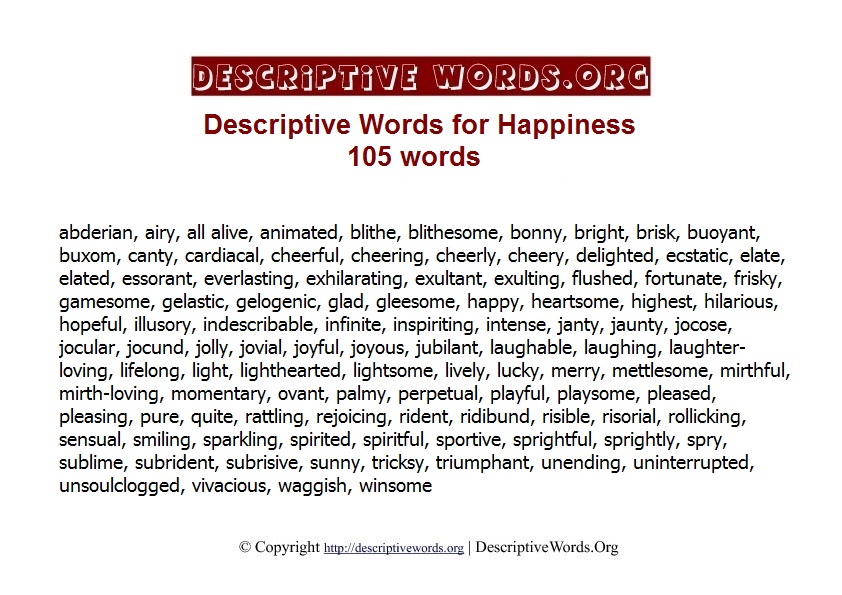
Here is a list of words that describe Happiness.
- abderian
- airy
- all alive
- animated
- blithe
- blithesome
- bonny
- bright
- brisk
- buoyant
- buxom
- canty
- cardiacal
- cheerful
- cheering
- cheerly
- cheery
- delighted
- ecstatic
- elate
- elated
- essorant
- everlasting
- exhilarating
- exultant
- exulting
- flushed
- fortunate
- frisky
- gamesome
- gelastic
- gelogenic
- glad
- gleesome
- happy
- heartsome
- highest
- hilarious
- hopeful
- illusory
- indescribable
- infinite
- inspiriting
- intense
- janty
- jaunty
- jocose
- jocular
- jocund
- jolly
- jovial
- joyful
- joyous
- jubilant
- laughable
- laughing
- laughter-loving
- lifelong
- light
- lighthearted
- lightsome
- lively
- lucky
- merry
- mettlesome
- mirthful
- mirth-loving
- momentary
- ovant
- palmy
- perpetual
- playful
- playsome
- pleased
- pleasing
- pure
- quite
- rattling
- rejoicing
- rident
- ridibund
- risible
- risorial
- rollicking
- sensual
- smiling
- sparkling
- spirited
- spiritful
- sportive
- sprightful
- sprightly
- spry
- sublime
- subrident
- subrisive
- sunny
- tricksy
- triumphant
- unending
- uninterrupted
- unsoulclogged
- vivacious
- waggish
- winsome
Happiness words are listed in alphabetical order.
Total number of Happiness words and adjectives: 105 words
Download Happiness Words PDF: Descriptive Words for Happiness PDF