The ocean is one of the most written-about environments on earth — and one of the most difficult to describe without cliché. The vocabulary for the ocean must capture its scale, its movement, its color, its sound, its smell, and its profound effect on the people who encounter it. This guide gives you 82 adjectives for the ocean and sea, organized by visual quality, movement, mood, and sensory experience, with definitions and example sentences.
Words for Ocean Color and Appearance
- Azure — bright, clear blue; the ideal ocean color of travel photography. “Azure shallows over white sand that made the water look artificial.”
- Cerulean — deep, serene blue; the color of deep calm water. “Cerulean expanse from the headland — the sea at its most composed.”
- Turquoise — blue-green; shallow tropical water over pale sand. “Turquoise lagoon that needed no filter and no improvement.”
- Jade — cool green; the color of rougher northern seas. “Jade-green Atlantic in March — alive and cold and serious.”
- Gunmetal — dark grey; the color of northern ocean in winter. “Gunmetal sea under a winter sky — the color of endurance.”
- Ink-black — deep, lightless black; the ocean at night. “Ink-black ocean at three in the morning — a darkness with movement.”
- Silver — metallic and reflective; the ocean under moonlight or overcast sky. “Silver sea under clouds that could not decide whether to rain.”
- Foam-flecked — marked with white foam; showing wind or current. “Foam-flecked surface that showed where the current ran.”
Words for Ocean Movement and State
- Calm — undisturbed; a flat or gently moving sea. “Calm sea that reflected the sky perfectly.”
- Placid — peacefully calm; undisturbed by wind or current. “Placid bay in the early morning — the water glass-flat.”
- Turbulent — violently disturbed; churning and chaotic. “Turbulent sea that made the crossing an act of commitment.”
- Choppy — having short, rough waves; uncomfortable for small boats. “Choppy conditions that were technically safe and practically unpleasant.”
- Heaving — rising and falling in large swells. “Heaving Atlantic crossing that required everything the ship had.”
- Surging — moving with powerful forward motion; waves and current. “Surging tide that covered the causeway in twenty minutes.”
- Rolling — moving in long, smooth, continuous waves. “Rolling Pacific swells that had been building since Japan.”
- Glassy — perfectly smooth; mirror-flat. “Glassy morning sea — the rare condition that makes fishermen quiet.”
- Sparkling — catching light on its surface; dancing with reflected light. “Sparkling afternoon sea that made sunglasses feel inadequate.”
- Raging — violently stormy; ferocious in its energy. “Raging storm sea that made the harbor wall look very small.”
Words for Ocean Mood and Atmosphere
- Vast — of immense extent; its scale defies comprehension. “Vast in a way that made the ship feel like punctuation.”
- Endless — seeming to have no boundary; the horizon always retreating. “Endless Pacific that the charts failed to adequately communicate.”
- Fathomless — impossibly deep; impossible to sound or measure. “Fathomless beneath the keel — the thought best not dwelt upon.”
- Ancient — older than any human concept; primordial. “Ancient rhythms of the tide that precede every human concern.”
- Powerful — immense in its force; capable of overwhelming anything. “Powerful beyond any human counter — the only appropriate response is respect.”
- Mysterious — concealing unknown depths and contents. “Mysterious beneath the surface — ninety-five percent unexplored.”
- Serene — profoundly calm; peaceful in a way that affects the observer. “Serene at dawn before the wind arrived — the ocean’s daily grace period.”
- Melancholic — deeply and pleasantly sad; the ocean’s emotional register for certain observers. “Melancholic in the specific way of large grey seas in autumn.”
- Majestic — impressively grand; inspiring awe. “Majestic scale that no photograph has ever successfully contained.”
Frequently Asked Questions
What are the best adjectives to describe the ocean?
For color: azure, cerulean, turquoise, jade, gunmetal, and silver. For movement: calm, placid, turbulent, choppy, glassy, heaving, and rolling. For mood: vast, fathomless, ancient, majestic, mysterious, and serene. The most effective ocean descriptions specify the time of day, season, and weather — the ocean is one of the most variable environments on earth, and ‘beautiful ocean’ describes almost nothing. ‘A jade-green Atlantic in March, choppy and cold and serious’ describes something real.
What words describe a calm ocean?
Calm ocean vocabulary: placid (peacefully undisturbed), glassy (mirror-flat surface), serene (profoundly peaceful), still (no movement), tranquil (quietly calm), millpond-flat (the specific British idiom for perfect calm — a millpond has no current), and glass-calm (technical sailing term for the flattest sea conditions). ‘Glassy’ is the most specific calm-water adjective — it implies not just calmness but the reflective, mirror-like quality of truly flat water.
What are literary or poetic words for the ocean?
‘Pelagic’ (of the open sea), ‘brine’ (salt water — the ocean’s literary name), ‘the deep’ (the ocean’s depth as a place), ‘fathomless’ (impossible to sound or measure), ‘the briny deep’ (poetic ocean), ‘azure main’ (the blue ocean — archaic and poetic), ‘the vasty deep’ (Shakespeare’s phrase from Henry IV), and ‘the wine-dark sea’ (Homer’s epithet — the specific blue-red of the Aegean in certain lights). Homer’s ‘wine-dark sea’ is the most famous ocean description in literature and the most argued over.
How do writers describe the ocean in fiction?
The ocean in fiction is almost always a character rather than a setting — it acts, it threatens, it gives and takes away. Melville’s ocean in Moby Dick is white and obsessive; Conrad’s ocean in Lord Jim is grey and indifferent; Hemingway’s ocean in The Old Man and the Sea is vast and worthy of respect. The most powerful ocean writing focuses on the relationship between the ocean and the human observer — what the ocean reveals about the person who stands before it.
What words describe ocean waves?
Wave vocabulary: crashing (the impact of a wave on shore or obstacle), rolling (long smooth swells), breaking (a wave that reaches its height and falls), surging (powerful forward movement), foaming (covered in white water), towering (unusually large), relentless (coming in continuous succession), and thundering (creating a thunder-like sound on impact). In surfing: ‘glassy’ (smooth-faced, ideal condition), ‘hollow’ (the specific barrel wave), and ‘pumping’ (powerful and consistently good waves).
The ocean is one of the most described subjects in the history of human writing, from Homer's “wine-dark sea” to Conrad's “destructive element.” It has inspired more language than almost any other natural phenomenon, because it is so many contradictory things at once: vast and intimate, beautiful and terrifying, eternal and ever-changing. This guide gives you 60+ words to describe the ocean, organized by mood, quality, and effect, with precise definitions and example sentences that show each word working in context.
Words for the Ocean's Scale and Power
The first thing the ocean impresses upon you is its sheer size and force.
- Vast — immeasurably large; extends beyond the limits of vision. “The vast Pacific stretched in every direction without a single landmark.”
- Boundless — having no visible edge or limit; apparently infinite. “She stood at the prow watching the boundless grey-green water.”
- Immense — of overwhelming physical size; dwarfs everything near it. “The immense weight of water above the wreck was something he tried not to think about.”
- Relentless — never stops, never rests, never pauses; the ocean's most essential quality. “The relentless pounding of the surf had worn the cliff back three feet in a decade.”
- Powerful — physically forceful; capable of moving ships, reshaping coastlines, ending lives. “The powerful current pulled him sideways before he had taken ten strokes.”
- Overwhelming — too large and forceful to resist or fully comprehend. “The overwhelming scale of the open ocean made the boat feel like a matchstick.”
- Primordial — as ancient as the beginning of life itself; evoking the origin of everything. “There is something primordial about the smell of the sea — it reaches something very old in the brain.”
Words for the Calm, Beautiful Ocean
- Serene — calm, peaceful, and undisturbed; the ocean on a perfect morning. “A serene expanse of water, barely rippled, reflecting the pink of the early sky.”
- Glassy — so flat and still that it reflects like a mirror; the ultimate calm. “The sea was glassy at dawn, the hull moving through it like a knife through silk.”
- Crystalline — so clear and transparent that you can see to great depth. “The crystalline water of the cove showed every pebble on the seabed.”
- Luminous — glowing with light; the ocean on a bright day seems to generate its own radiance. “The luminous turquoise of the shallows gave way to a deep and impossible blue.”
- Shimmering — the play of light across moving water; sparkle and movement combined. “The shimmering surface was almost too bright to look at directly.”
- Tranquil — peaceful and free from disturbance; the ocean in a protected bay on a summer afternoon. “A tranquil anchorage where the water barely moved and the sun was warm.”
- Pellucid — perfectly clear and transparent; a literary word for water of exceptional clarity. “The pellucid water of the atoll made the boat appear to float on air.”
- Cerulean — a specific shade of deep, clear blue associated with tropical waters and open skies. “The cerulean expanse stretched to the horizon without a single cloud.”
Words for the Stormy, Dangerous Ocean
- Tempestuous — violently stormy; wild with wind and wave. “The tempestuous North Atlantic flung spray across the deck every thirty seconds.”
- Churning — in a state of violent, agitated motion; rolling and turning without pause. “The churning water between the rocks made any attempt to land suicidal.”
- Turbulent — disturbed and unstable; shifting unpredictably in direction and force. “Turbulent seas had scattered the fleet and left them navigating blind.”
- Merciless — shows no compassion; indifferent to human suffering. “The merciless sea took the ship in under an hour and offered no survivors.”
- Treacherous — apparently safe but concealing hidden dangers; the ocean at its most deceptive. “The treacherous shallows had claimed fishing boats for three hundred years.”
- Seething — boiling with violent motion; foam and fury combined. “The seething water at the base of the cliff roared and spat continuously.”
- Implacable — impossible to stop, reason with, or appease; the ultimate description of the ocean in a storm. “An implacable force that had humbled every civilization that built too close to its edge.”
- Savage — violent and untamed; the ocean at its most animal. “Savage seas that had not calmed in eleven days.”
Words for the Ocean's Depth and Mystery
- Fathomless — too deep to measure; also used metaphorically for something beyond comprehension. “The fathomless darkness below the thermocline was home to creatures no one had named.”
- Unfathomable — impossible to understand fully; mysterious beyond human grasp. “The unfathomable depth of the trench made even the submersible seem fragile.”
- Mysterious — conceals more than it reveals; the unknown is its defining characteristic. “Ninety percent of the ocean floor remains unmapped — it is the most mysterious terrain on earth.”
- Abyssal — relating to the ocean abyss; the deepest and darkest zones of the sea. “An abyssal plain stretches for thousands of miles in total silence.”
- Ancient — older than any human civilization; unchanged in its essential nature across millions of years. “There is something ancient and unrattled about the deep ocean.”
- Brooding — dark, heavy, and full of unspoken weight; the ocean under an overcast sky. “The brooding grey sea matched his mood precisely.”
The Ocean in Literature and Writing
Writers have always turned to the ocean as a mirror of the human inner life. It is simultaneously a symbol of freedom, danger, eternity, and the unconscious. Homer calls it “wine-dark”; Melville calls it “the great flood-gates of the wonder-world”; Virginia Woolf uses its rhythms to structure consciousness itself. When you describe the ocean in writing, ask what emotional state you want to evoke in the reader, then choose words whose sound and meaning work together: pellucid and luminous for peace; implacable and churning for dread.
Frequently Asked Questions
What are the best words to describe the ocean?
The most evocative ocean adjectives depend on what aspect you want to capture. For power: vast, boundless, relentless, churning, and immense. For beauty: serene, luminous, crystalline, and tranquil. For danger: treacherous, fathomless, brooding, and merciless.
What are poetic words for the ocean?
Some of the most poetic ocean adjectives: fathomless (unmeasurably deep), pellucid (transparently clear), cerulean (deep sky-blue), phosphorescent (glowing with cold light), and primordial (as ancient as the beginning of time).
How do you describe the sound of the ocean?
The sound of the ocean is described with: rhythmic, relentless, hushed (at low tide), thunderous (in a storm), hissing (as waves retreat), roaring (in rough weather), and murmuring (on a calm day). ‘Susurrant’ — meaning whispering or rustling — is perfect for the soft sound of gentle surf.
What words describe a rough, stormy ocean?
For a rough ocean: tempestuous, churning, violent, seething, relentless, heaving, turbulent, savage, and merciless. ‘Implacable’ is particularly strong — it means impossible to appease or stop.
What words describe a calm, beautiful ocean?
For a calm ocean: serene, glassy, luminous, crystalline, tranquil, placid, shimmering, and mirror-like. ‘Pellucid’ (crystal clear) and ‘cerulean’ (deep blue) are beautiful literary choices.
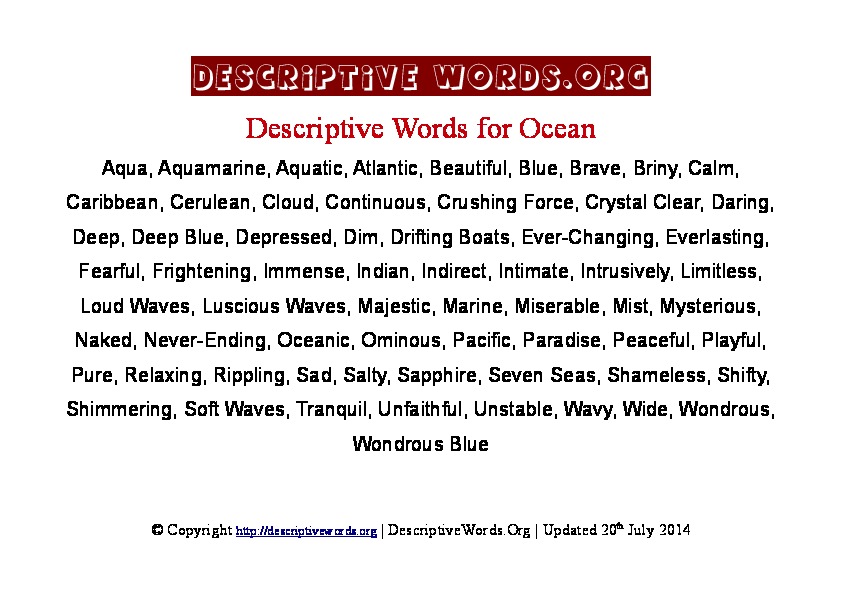
What are some descriptive words for the Ocean ?
Here is a list of words that describe the ocean.
Total number of ocean words and adjectives: 64 words
Ocean words are listed in alphabetical order.
aquamarine,
aquatic,
Atlantic,
beautiful,
blue,
brave,
briny,
calm,
Caribbean,
cerulean,
cloud,
continuous,
crushing force,
crystal clear,
daring,
deep,
deep blue,
depressed,
dim,
drifting boats,
ever-changing,
everlasting,
fearful,
frightening,
immense,
Indian,
indirect,
intimate,
intrusively,
limitless,
loud waves,
luscious waves,
majestic,
marine,
miserable,
mist,
mysterious,
naked,
never-ending,
oceanic,
ominous,
pacific,
paradise,
peaceful,
playful,
pure,
relaxing,
rippling,
sad, salty,
sapphire,
seven seas,
shameless,
shifty,
shimmering,
soft waves,
tranquil,
unfaithful,
unstable,
wavy,
wide,
wondrous,
wondrous blue .
Download ocean Words PDF: Descriptive Words for ocean PDF