Money is one of the most euphemism-rich topics in the English language — we avoid saying directly what we mean about wealth, poverty, cost, and financial status. A precise vocabulary for describing money, wealth, cost, and financial quality allows writers, journalists, and communicators to be specific and clear where most language is evasive or imprecise. This guide gives you 80 adjectives related to money and wealth, organized by level, quality, and attitude, with definitions and example sentences.
Words for Wealth and Affluence
- Wealthy — having a large amount of money or assets. “Wealthy in the understated way of old money — quality without display.”
- Affluent — having a comfortable and prosperous standard of living. “Affluent neighborhood where the houses were large and the gardens maintained.”
- Prosperous — successful and thriving financially. “Prosperous small business that had been profitable from the second year.”
- Opulent — lavishly wealthy; rich in a way that is visible and impressive. “Opulent interior that communicated wealth without pretending to subtlety.”
- Flush — having plenty of money, especially temporarily. “Flush after the bonus — a condition he had learned was temporary.”
- Well-heeled — informal: wealthy. “Well-heeled clientele who expected service without being asked twice.”
- Moneyed — having wealth, especially inherited wealth. “Moneyed in the specific sense that included the family house and no mortgage.”
- Gilded — superficially wealthy and privileged. “Gilded in the Mark Twain sense — the shine concealing the base metal.”
Words for Financial Difficulty
- Broke — informal: having no money. “Broke in the specific way of the end of the month before the salary arrived.”
- Impoverished — made poor; reduced to poverty. “Impoverished by the medical bills that had not been predicted and could not be avoided.”
- Destitute — extremely poor; without basic necessities. “Destitute after the collapse — nothing left except the debts.”
- Insolvent — unable to pay debts; technically bankrupt. “Insolvent but continuing to trade — the specific situation that creates legal jeopardy.”
- Strapped — informal: having very little money. “Strapped for cash in a way that required creative solutions.”
- Penurious — formal: extremely poor. “Penurious circumstances that required the sale of everything discretionary.”
- Hard-up — informal: short of money. “Hard-up in that specific way of people who are never quite in crisis and never quite comfortable.”
Words for Cost and Value
- Expensive — costs a lot of money; priced high. “Expensive in the way that required justification before purchase.”
- Costly — expensive; often implies the cost was a sacrifice. “Costly mistake that had been entirely preventable.”
- Exorbitant — unreasonably expensive; far more than is justified. “Exorbitant hotel rates during the conference week.”
- Extravagant — spending far more than is necessary; wasteful or luxurious. “Extravagant renovation that went three times over the original budget.”
- Affordable — priced within reach; reasonably cheap. “Affordable in the specific meaning of this neighborhood — relative to what preceded it.”
- Economical — not wasteful; gives good value relative to cost. “Economical choice that cost less and delivered more.”
- Frugal — careful with money; spends only what is necessary. “Frugal in the principled sense — not cheap, but deliberate.”
- Lucrative — producing a large profit. “Lucrative contract that justified the two years of preparation.”
- Nominal — very small in amount; almost free. “Nominal fee that was more about commitment than revenue.”
Words for Financial Attitude and Behavior
- Generous — gives freely; does not count the cost. “Generous with money in the specific way of people who had been without it.”
- Miserly — excessively unwilling to spend; hoards money. “Miserly in a way that cost more in relationships than it saved in money.”
- Thrifty — careful and prudent with money; saves without being mean. “Thrifty household that had no debt and three months of savings.”
- Profligate — recklessly extravagant; wastes money. “Profligate spending that had been invisible until the accounts arrived.”
- Prudent — careful and sensible in managing money. “Prudent financial management that had survived three recessions.”
Frequently Asked Questions
What are the best adjectives to describe wealth?
For great wealth: wealthy, affluent, opulent, prosperous, moneyed, and well-heeled. For show of wealth: lavish, extravagant, opulent, gilded, and ostentatious. For modest sufficiency: comfortable, solvent, secure, and stable. The most specific wealth adjective depends on whether the wealth is displayed or concealed: old money is ‘understated’ and ‘established’; new money is ‘ostentatious’ and ‘conspicuous’; earned wealth is ‘hard-won’ and ‘deserved.’
What are literary or elevated words for money and wealth?
‘Pecuniary’ (relating to money — formal), ‘lucre’ (money, especially when gained dishonestly — ‘filthy lucre’), ‘mammon’ (wealth as an idol, from the Bible), ‘plutocrat’ (someone who rules through wealth), ‘plutocracy’ (rule by the wealthy), ‘penury’ (extreme poverty — formal), ‘indigent’ (poor and needy — formal), and ‘solvent’ (able to pay debts). ‘Mammon’ is the most culturally loaded money word — it implies that the pursuit of wealth has become a form of worship.
How do you describe an expensive item or experience?
Expensive vocabulary: costly (implies sacrifice), pricey (informal and colloquial), premium (justified by quality), luxury (associated with exceptional quality and exclusivity), exorbitant (unreasonably expensive), extravagant (far more than necessary), and eye-watering (informal: so expensive as to be shocking). The distinction between ‘expensive’ and ‘premium’: expensive implies the price may not be justified; premium implies the quality justifies the cost.
What words describe someone who is careful with money?
Careful with money vocabulary: frugal (careful and deliberate), thrifty (prudent and saves without being mean), economical (gets good value), prudent (sensible and careful), abstemious (moderate, especially with food and drink), and parsimonious (excessively sparing — more negative). The distinction between ‘frugal’ and ‘miserly’: frugal implies deliberate and principled economy; miserly implies an excessive and damaging unwillingness to spend even when spending would be appropriate.
What are words for financial success?
Financial success vocabulary: profitable (generates more than it costs), lucrative (produces large profit), prosperous (thriving financially), solvent (able to pay all debts), viable (sustainable as a business), successful (achieves its financial goals), and thriving (growing and doing well). The most specific financial success adjective for a business is ‘profitable’ — it means the revenue exceeds the costs, which is the only measure of commercial sustainability that ultimately matters.
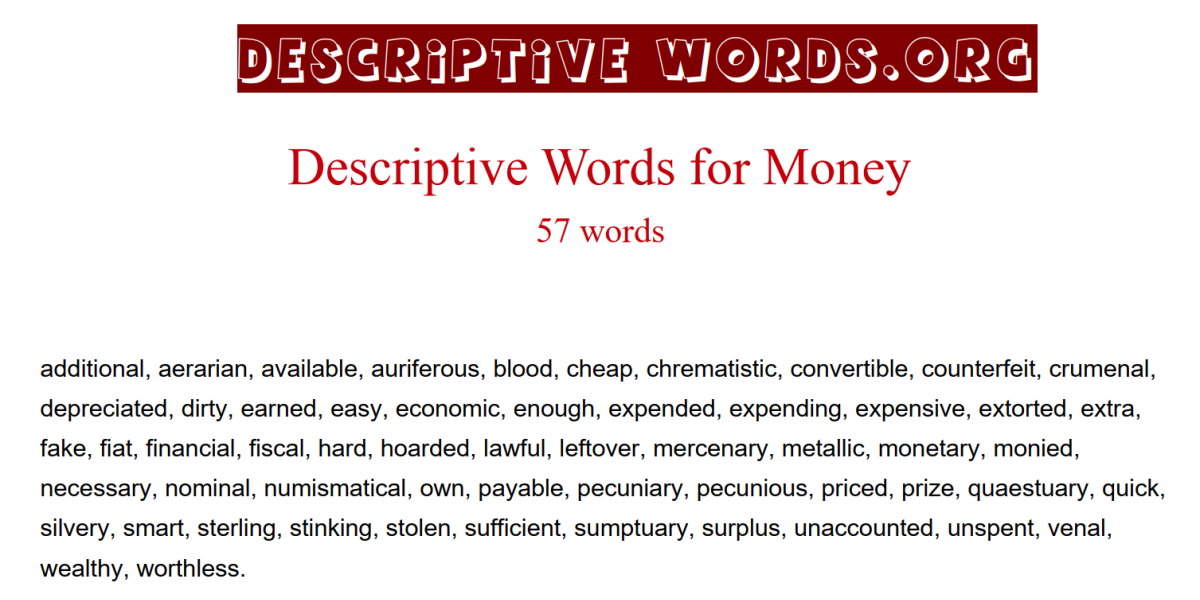
What are descriptive words for Money?
Here is a list of words that describe Money:
- additional
- aerarian
- available
- auriferous
- blood
- cheap
- chrematistic
- convertible
- counterfeit
- crumenal
- depreciated
- dirty
- earned
- easy
- economic
- enough
- expended
- expending
- expensive
- extorted
- extra
- fake
- fiat
- financial
- fiscal
- hard
- hoarded
- lawful
- leftover
- mercenary
- metallic
- monetary
- monied
- necessary
- nominal
- numismatical
- own
- payable
- pecuniary
- pecunious
- priced
- prize
- quaestuary
- quick
- silvery
- smart
- sterling
- stinking
- stolen
- sufficient
- sumptuary
- surplus
- unaccounted
- unspent
- venal
- wealthy
- worthless
Words referencing Money are listed in alphabetical order.
Total number of Money words and adjectives: 57 words
Download Money Words PDF: Descriptive Words for Money PDF