Describing boys — from toddlers to teenagers — requires vocabulary that captures the full range of physical energy, emotional complexity, and developmental stages that define boyhood. This guide gives you 85 adjectives to describe boys, organized by age, personality, appearance, and behavior.
Words for Young Boys (Toddler to Age 8)
- Boisterous — noisily energetic; physically active and difficult to contain. “Boisterous in the way of boys who have just discovered running.”
- Inquisitive — asks why about everything; driven by genuine curiosity. “Inquisitive beyond any adult’s ability to fully satisfy.”
- Fearless — approaches danger without hesitation; before risk assessment develops. “Fearless in the way that requires constant adult supervision.”
- Spirited — full of energy and enthusiasm; high-intensity in the best sense. “A spirited boy who needed more and gave back more.”
- Mischievous — fond of causing mild trouble; playfully naughty. “Mischievous in a way that was difficult to stay angry about.”
- Affectionate — gives and seeks physical warmth; full-body hugs without warning. “Affectionate in the sudden, complete way of young children.”
- Imaginative — creates rich fictional worlds from simple materials. “Imaginative with a cardboard box in a way no purchased toy could match.”
- Rough-and-tumble — physically playful; prefers active, contact play. “Rough-and-tumble in a way that alarmed visitors and delighted him.”
Words for Older Boys (Age 9 to Teenager)
- Restless — unable to stay still or settled; energy needing an outlet. “Restless in class and transformed on the sports field.”
- Earnest — sincere and serious; says what he means. “Earnest in his enthusiasm in a way that adults found disarming.”
- Loyal — stands by his friends without condition. “Loyal in the fierce, uncomplicated way of boyhood friendship.”
- Competitive — strongly motivated to win; measures himself against others. “Competitive at everything, including board games with his grandmother.”
- Headstrong — determined to do things his own way; resistant to direction. “Headstrong — he had decided and that was the end of the discussion.”
- Sensitive — emotionally responsive; more affected by things than he shows. “Sensitive in a way he had learned to disguise by the age of ten.”
- Resilient — bounces back from setbacks; falls down and tries again. “Resilient in the physical and emotional sense — scraped knees and bruised pride both healed fast.”
- Curious — driven to understand how things work; takes things apart. “Curious about mechanisms in a way that was expensive for the household electronics.”
Physical Description
- Gangly — tall and awkwardly thin; limbs not yet proportional. “Gangly teenager who had grown four inches in a year and not yet adjusted.”
- Stocky — solidly and compactly built; broad and strong. “Stocky and strong — built for rugby rather than cross-country.”
- Lanky — tall and thin with long limbs; loose and ungainly. “Lanky in the way of boys who have not yet grown into themselves.”
- Wiry — lean but surprisingly strong. “Wiry and fast — deceptive in both speed and strength.”
- Rosy-cheeked — pink-cheeked from exertion or cold. “Rosy-cheeked from the cold and the running.”
- Tousled — pleasantly disheveled hair; casually disordered. “Tousled hair that resisted every effort to tame it.”
Frequently Asked Questions
What are good adjectives to describe a boy?
Energetic and physical: boisterous, spirited, fearless, rough-and-tumble, and restless. Character-based: loyal, earnest, curious, resilient, and inquisitive. Physical appearance: gangly, wiry, stocky, rosy-cheeked, and tousled. The most vivid boy descriptions combine one physical detail with one character trait: ‘a wiry, fiercely loyal eight-year-old’ creates a specific and real person.
What words describe a well-behaved boy?
Well-behaved boy adjectives: polite, considerate, composed, attentive, earnest, respectful, and self-disciplined. In fiction writing, a completely well-behaved boy is rarely interesting — the most compelling young male characters have one or two positive traits that coexist with a flaw or struggle that makes them real.
What are words for a mischievous boy?
Mischievous boy vocabulary: impish (playfully naughty), roguish (charmingly dishonest), wily (clever in a sneaky way), incorrigible (impossible to correct), headstrong (determined to do his own thing), irrepressible (impossible to contain), and unruly (resistant to authority). Tom Sawyer is the literary archetype: ‘mischievous, brave, and entirely his own person.’
How do authors write boy characters in fiction?
The best boy characters in literature are defined by a specific combination of courage and vulnerability: Tom Sawyer (brave and morally adventurous), Huck Finn (free and searching for belonging), Ender Wiggin (brilliant and lonely), and Scout Finch’s brother Jem (growing into moral awareness). The most memorable boy characters are specific rather than generic — one unusual detail, one contradiction, one thing they want badly.
What positive words describe a teenage boy?
Positive teenage boy adjectives: resilient (recovers from setbacks), earnest (sincere and genuine), ambitious (driven toward goals), curious (genuinely interested in the world), principled (guided by emerging values), and loyal (stands by those he cares about). Teenage years are typically described through the tension between dependence and independence — the most precise vocabulary captures that specific in-between quality.
Finding exactly the right words to describe a boy — whether you are a parent writing a birthday tribute, a teacher filling in a report, a novelist building a young character, or simply looking for the perfect adjective — takes more thought than it might seem. Boys are complex, contradictory, and endlessly varied. This guide gives you 57 carefully chosen adjectives to describe a boy, organized by personality, behavior, appearance, and emotional qualities, with definitions and example sentences for each.
Words to Describe a Boy's Personality
Personality adjectives capture who a boy is at his core — his character traits that stay consistent across situations.
- Adventurous — eager to try new things and explore the unknown, without much fear of risk. “The adventurous eight-year-old had already climbed every tree in the neighborhood.”
- Curious — driven by a powerful desire to understand how things work and why. “The curious boy dismantled his alarm clock the day after Christmas.”
- Spirited — full of energy, enthusiasm, and a strong sense of self; not easily contained. “A spirited child, he could turn a quiet afternoon into an expedition.”
- Imaginative — able to create vivid mental worlds; sees possibilities where others see ordinary things. “The imaginative boy had built an entire kingdom out of cardboard boxes.”
- Resourceful — solves problems creatively with whatever is at hand. “Locked out of the house, the resourceful ten-year-old rigged a solution from a garden hose and a stick.”
- Determined — will not give up once he sets his mind to something. “Determined to ride without training wheels, he fell seventeen times before he got it.”
- Empathetic — unusually sensitive to the feelings of others for his age. “The empathetic boy noticed his friend was upset before any adult did.”
- Thoughtful — considers others before acting; shows care through small, deliberate gestures. “He was the kind of thoughtful boy who always saved the last biscuit for his sister.”
- Witty — quick with clever humor; often the class comedian with actual intelligence behind the jokes. “The witty twelve-year-old had a comeback for everything.”
- Earnest — sincere and serious about things he cares about; no irony, no pretense. “He was an earnest boy who took every promise as a contract.”
Words to Describe a Boy's Behavior
Behavioral adjectives describe how a boy acts day-to-day — useful for parents, teachers, and writers alike.
- Energetic — physically active and constantly in motion; difficult to tire out. “The energetic six-year-old had lapped the garden four times before breakfast.”
- Boisterous — noisily enthusiastic; creates a physical presence wherever he goes. “The boisterous boy burst into the room like a small thunderstorm.”
- Mischievous — enjoys causing minor trouble, usually with a grin and no malice. “The mischievous look in his eyes told her the frog was already in her bag.”
- Reckless — acts without thinking about consequences; takes risks without calculating them. “The reckless boy jumped from the highest rock into the lake without checking the depth.”
- Gentle — handles things and people with care and softness; the opposite of rough. “The gentle boy crouched to move the earthworm off the path so no one would step on it.”
- Rambunctious — wildly energetic, unruly, and difficult to keep still; joyfully chaotic. “The rambunctious twins had converted the living room into an obstacle course.”
- Disobedient — consistently refuses to follow rules or instructions; tests every boundary. “Disobedient at school, he was nonetheless deeply principled at home.”
- Cooperative — works willingly with others; does not resist authority unnecessarily. “The cooperative boy divided the tasks fairly among the group without being asked.”
- Impulsive — acts on immediate feeling or desire without pause for thought. “His impulsive nature meant brilliant ideas and unfortunate accidents arrived in equal measure.”
Words to Describe a Boy's Appearance
- Lanky — tall and thin, with limbs that seem slightly too long for his body. “The lanky teenager folded himself into the small school desk with difficulty.”
- Stocky — solidly built, with a broad frame; strong without being overweight. “The stocky boy was the natural choice for the rugby front row.”
- Freckled — scattered with small brown spots across the nose and cheeks; often associated with outdoor, sun-kissed childhood. “The freckled boy had spent most of the summer outdoors.”
- Cherubic — angelic and round-faced; the classic appearance of innocent early childhood. “Nobody could stay angry at that cherubic face for long.”
- Wiry — slim but visibly strong; lean muscle rather than bulk. “The wiry boy was deceptively strong and quick on the football pitch.”
- Disheveled — untidy in appearance; hair sticking up, shirt untucked, shoes muddy. “The disheveled state of his clothes was a reliable record of his afternoon.”
- Ruddy — having a healthy reddish complexion, often from outdoor activity. “Ruddy-cheeked from the cold, he tumbled through the door demanding hot chocolate.”
Words to Describe a Boy's Emotional Qualities
- Sensitive — feels things deeply; may be hurt by criticism and moved by beauty or sadness. “The sensitive boy cried at the end of every film, and never apologized for it.”
- Resilient — bounces back from setbacks quickly; does not stay down for long. “Despite the difficult year, the resilient boy emerged with his humor intact.”
- Vulnerable — open to being hurt; often masked by toughness but present underneath. “Beneath the bravado, the boy was deeply vulnerable.”
- Exuberant — overflows with joy, enthusiasm, and positive energy. “The exuberant child greeted every morning as if it were his birthday.”
- Brooding — given to deep, often troubled thought; inward and contemplative in a heavy way. “The brooding teenager spent hours alone in his room with his notebooks.”
- Cheerful — consistently in a good mood; easy to be around, lifts the atmosphere. “The cheerful boy had not met a stranger he couldn't befriend within five minutes.”
How to Use These Words When Writing About Boys
The best descriptions combine two or three adjectives that create an interesting tension or surprise. A boy described as both gentle and reckless is immediately more interesting than one described as simply good. Look for the contradiction — the brooding boy who is secretly exuberant, the boisterous child who is surprisingly empathetic. That tension is where character lives.
Frequently Asked Questions
What are positive words to describe a boy?
Some of the best positive adjectives to describe a boy include adventurous, curious, determined, empathetic, resilient, and thoughtful. Each one points to a genuine strength rather than a vague compliment. Used in school reports, these words show a teacher's real attention to the individual child.
What are words to describe a naughty or difficult boy?
Mischievous is playful and affectionate. Reckless is more serious, implying real risk. Disobedient is direct and behavioral. Impulsive implies the behavior comes from temperament rather than intention. Choose based on the tone and context of what you are writing.
What words describe a young boy differently from a teenage boy?
Young boys (ages 4-8) are often described as cherubic, boisterous, rambunctious, exuberant. Teenage boys tend to be described with more complex emotional vocabulary: brooding, resilient, witty, earnest, vulnerable. The shift from physical to emotional descriptors mirrors the psychological development of adolescence.
How do authors describe boys in literature?
Classic literature shows the range: Tom Sawyer is mischievous, adventurous, and spirited. Oliver Twist is gentle, earnest, and vulnerable. Holden Caulfield is sensitive, brooding, and reckless. The best literary boys are described through specific, contradictory adjectives that make them feel real rather than archetypal.
What are some descriptive words for Boy?
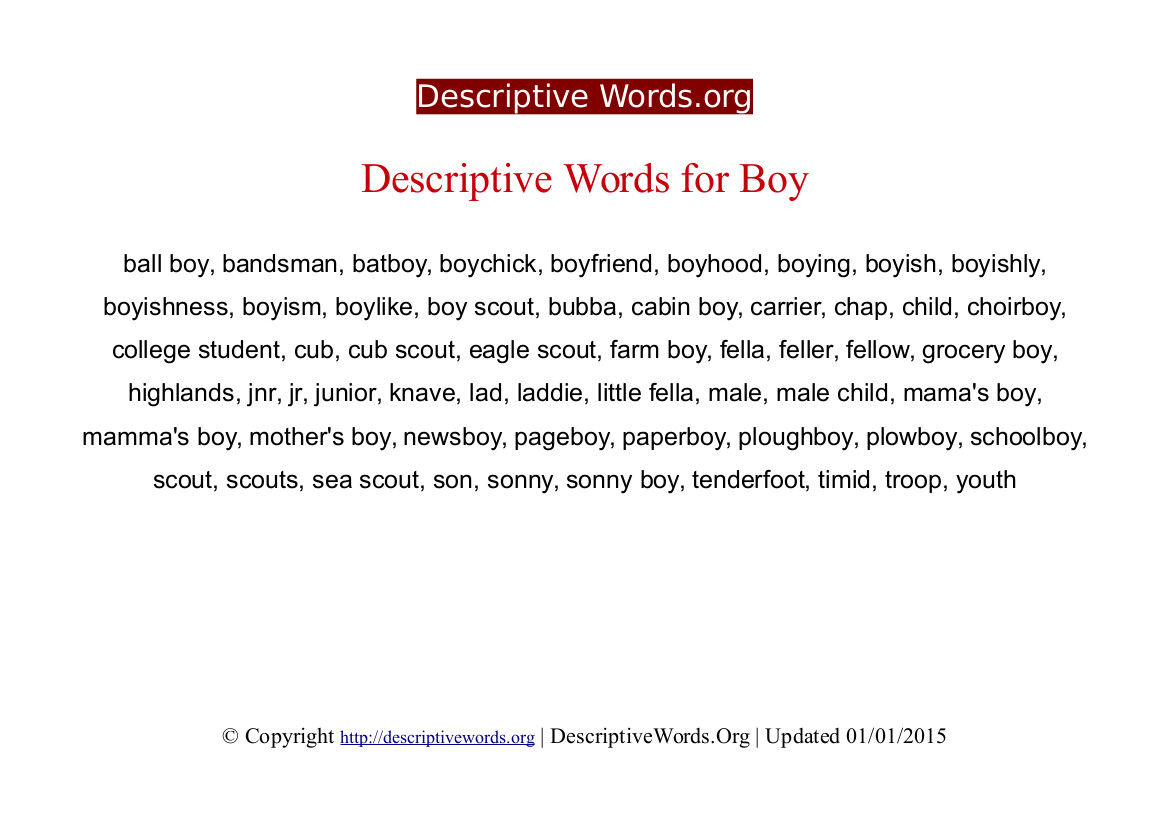
Here is a list of words that describe Boy.
Total number of Boy words and adjectives: Boy 57 words
Boy words are listed in alphabetical order.
bandsman,
batboy,
boychick,
boyfriend,
boyhood,
boying,
boyish,
boyishly,
boyishness,
boyism,
boylike,
boy scout,
bubba,
cabin boy,
carrier,
chap,
child,
choirboy,
college student,
cub,
cub scout,
eagle scout,
farm boy,
fella,
feller,
fellow,
grocery boy,
highlands,
jnr,
jr,
junior,
knave,
lad,
laddie,
little fella,
male,
male child,
mama’s boy,
mamma’s boy,
mother’s boy,
newsboy,
pageboy,
paperboy,
ploughboy,
plowboy,
schoolboy,
scout,
scouts,
sea scout,
son,
sonny,
sonny boy,
tenderfoot,
timid,
troop,
youth.