Cold is one of the most physically immediate sensory experiences — it cannot be ignored, it changes behavior, and it carries powerful emotional and metaphorical associations. The vocabulary for cold goes far beyond the simple word itself, offering precise terms for different intensities, qualities, and contexts of low temperature. This guide gives you 68 adjectives for cold, organized by intensity, quality, and metaphorical use, with definitions and example sentences.
Words for Extreme Cold
- Frigid — intensely cold; the cold of deep winter or glacial water. “Frigid river crossing that drove the breath out and the logic with it.”
- Arctic — of Arctic intensity; extreme and biting. “Arctic wind off the North Sea that made the coast feel hostile.”
- Glacial — cold as a glacier; extreme and deep. “Glacial meltwater that was cold in a way that felt ancient.”
- Bitter — intensely cold in a way that stings. “Bitter January cold that made every breath visible and every thought short.”
- Biting — sharp and penetrating; cold that seems to cut. “Biting wind that found every gap in the clothing.”
- Piercing — cold that penetrates; cuts through layers. “Piercing frost that reached through the walls of the old house.”
- Bone-chilling — so cold it seems to reach the bones. “Bone-chilling damp of an English February — worse than dry cold.”
- Raw — cold and damp; the worst combination for exposed skin. “Raw March morning that was not the coldest but felt the worst.”
- Numbing — cold that removes sensation; deadens feeling. “Numbing cold that made the hands useless within minutes.”
Words for Moderate Cold
- Brisk — pleasantly cool and invigorating; energizing cold. “Brisk autumn morning that made everything feel more possible.”
- Crisp — pleasantly cold and clear; fresh and sharp. “Crisp November air that smelled of leaf mold and the year ending.”
- Chilly — uncomfortably cool; more than cool, not yet cold. “Chilly enough to need a jacket but not enough to justify a coat.”
- Cool — comfortably below warm; refreshing. “Cool cellar air in summer — the specific luxury of old stone.”
- Fresh — clean and cool; invigorating rather than uncomfortable. “Fresh morning air before the heat built — the day’s best hour.”
- Nippy — informal: sharp and cold; mildly biting. “Nippy enough to see your breath — the first sign of the season turning.”
- Wintry — having the qualities of winter; cold, grey, and bare. “Wintry scene that needed only snow to be complete.”
Words for the Quality of Cold
- Icy — covered in or cold as ice; immediately felt. “Icy doorstep that required scraping before dawn.”
- Frosty — covered in frost; the specific cold of freezing moisture. “Frosty morning — grass stiff and white and the world held in suspension.”
- Bleak — cold and comfortless; lacking warmth in all senses. “Bleak midwinter landscape that made indoors feel like a moral position.”
- Damp — cold combined with moisture; the most pervasive and penetrating kind. “Damp cold of the English climate — mild in temperature, ruthless in effect.”
- Penetrating — goes through clothing and skin; reaches the core. “Penetrating cold that made thick coats feel ornamental.”
- Perishing — British informal: extremely cold; intensely uncomfortable. “Perishing on the football terraces — the specific cold of commitment.”
Metaphorical Cold Words
- Cold — emotionally distant; without warmth or feeling. “Cold response that answered the question and closed the conversation.”
- Icy — hostile and unfriendly; the emotional temperature of a frozen relationship. “Icy silence that communicated more than the argument had.”
- Frigid — emotionally rigid and unresponsive. “Frigid atmosphere in the boardroom that made the presentation shorter.”
- Frosty — unfriendly and unwelcoming; the early stage of icy. “Frosty reception that made the purpose of the visit clear.”
- Glacial — extremely slow; also extremely cold emotionally. “Glacial progress in the relationship — neither forward nor back.”
Frequently Asked Questions
What are better words for cold weather?
Instead of ‘cold’: frigid (intensely cold), arctic (extreme cold), bitter (stinging cold), biting (sharp and penetrating), bone-chilling (deep cold), raw (cold and damp), brisk (invigorating cool), crisp (pleasantly sharp), and wintry (having qualities of winter). Each describes a different combination of temperature, moisture, wind, and bodily effect. ‘Raw’ is the most specific British English cold word — it describes the damp, penetrating cold that is more uncomfortable than dry cold at the same temperature.
What are literary words for cold?
‘Gelid’ (very cold — from Latin gelu, frost), ‘algid’ (cold, especially from fever — medical term), ‘hibernal’ (of or relating to winter), ‘boreal’ (relating to the cold north), ‘hyperborean’ (of the extreme north — from the Greek mythology of the Hyperboreans), and ‘brumal’ (relating to winter, wintery) are rare literary cold vocabulary. Keats uses ‘cold’ memorably in ‘The Eve of St. Agnes’: ‘St. Agnes’ Eve — Ah, bitter chill it was!’
How do writers describe cold in fiction?
The most effective cold descriptions in fiction anchor in physical sensation and behavioral consequence: cold changes what characters can do (numb fingers, visible breath, shortened thought), where they want to go (toward heat and shelter), and how they feel about their situation. Cold is the great equalizer — it is one of the few sensations that overrides almost all others. The best cold scenes show the cold through its effects: ‘his hands had stopped working twenty minutes ago’ is more vivid than ‘it was very cold.’
What words describe cold water?
Cold water vocabulary: icy (immediately cold on contact), frigid (intensely cold), biting (sharp and stinging), numbing (removes sensation), bone-chilling (penetrates to the core), glacial (cold as meltwater), bracing (cold but invigorating), and refreshing (pleasantly cool). The difference between ‘bracing’ and ‘frigid’ is the relationship to the cold: ‘bracing’ implies the swimmer chose it and benefits; ‘frigid’ implies the cold is unwanted and dangerous.
What does cold symbolize in writing?
Cold symbolizes: emotional distance and isolation, death and its approach (the cold of the dead), clarity and precision (cold logic, cold hard facts), cruelty (cold-blooded), winter and its associations (endings, waiting, dormancy), and the inhuman (cold as machine, cold as the void). Cold is one of the most symbolically dense physical states in literature — it almost never appears without carrying meaning beyond temperature.
From the bitter snap of a winter morning to the icy chill of an air-conditioned room, cold is one of the most sensory experiences we can describe. Whether you are writing a novel, crafting a weather report, describing a person's demeanor, or painting a scene in a poem, having a precise vocabulary for cold will transform your writing from flat to vivid. Below you will find 46 carefully defined adjectives for cold, organized by intensity and type, with example sentences to show each word in context.
Adjectives for Cold — Organized by Intensity
Mildly Cold
These words describe a gentle, refreshing or slightly uncomfortable coolness — not yet painful or dangerous.
- Cool — pleasantly low in temperature, often a relief rather than a discomfort. “A cool breeze drifted through the open window on the August evening.”
- Crisp — refreshingly cold and dry, often associated with autumn mornings and clear air. “The crisp October air carried the scent of fallen leaves.”
- Brisk — cold enough to feel sharp and invigorating; stimulating rather than unpleasant. “She pulled her scarf tighter against the brisk morning air.”
- Chilly — noticeably cold, making you reach for a jacket; more uncomfortable than cool. “The evening turned chilly as the sun dipped below the hills.”
- Nippy — colloquial for slightly sharp or biting cold, often used affectionately. “It's a bit nippy out there — you'll want gloves.”
- Raw — unpleasantly cold and damp, often combined with wind; penetrating and cheerless. “A raw February day kept everyone indoors by the fire.”
Moderately Cold
A deeper, more uncomfortable level of cold that demands proper clothing and preparation.
- Cold — the baseline descriptor; a low temperature that causes discomfort. “The cold water of the mountain stream shocked him awake.”
- Frosty — cold enough to produce frost; surfaces sparkle with ice crystals. “Frosty windowpanes distorted the shapes of the trees outside.”
- Wintry — characteristic of winter; suggesting grey skies, bare trees, and persistent cold. “A wintry landscape stretched endlessly in every direction.”
- Icy — as cold as ice; either literally covered in ice or metaphorically frigid. “The icy road forced drivers to slow to a crawl.”
- Biting — cold that feels as though it is physically cutting into the skin. “A biting wind tore across the open field, stealing her breath.”
- Piercing — cold so sharp it seems to pass through clothing and skin. “The piercing cold of the mountaintop made her eyes water.”
- Sharp — an immediate, keen coldness that hits the senses directly. “He stepped outside and felt the sharp cold sting his cheeks.”
Severely Cold
Extreme, dangerous cold that dominates the environment and threatens the body.
- Frigid — intensely cold; well below freezing and physically threatening. “Frigid temperatures kept the expedition team confined to their tents for three days.”
- Arctic — as cold as the polar regions; used for the most extreme cold. “Arctic conditions descended on the city, freezing pipes and stranding commuters.”
- Glacial — cold as a glacier; also used metaphorically for an extremely slow or cold demeanor. “A glacial wind swept down from the north, turning the harbour to grey slush.”
- Bitter — a penetrating, relentless cold that feels hostile and unforgiving. “Bitter cold had turned the puddles to solid ice overnight.”
- Frozen — at or below the freezing point; solid with cold. “Her fingers were so frozen she could no longer feel the car keys.”
- Numbing — so cold that it removes sensation; makes extremities stop working. “Numbing cold crept up his legs as he stood in the snowdrift.”
- Bone-chilling — cold that seems to penetrate to the skeleton itself. “A bone-chilling wind howled through the abandoned factory.”
- Polar — associated with the harshest cold regions on earth; extreme and relentless. “Polar temperatures gripped the region for two unbroken weeks.”
Cold Used Metaphorically
Cold is one of the most powerful metaphors in the English language — we use it constantly to describe emotions, personalities, and relationships.
- Icy (demeanor) — unfriendly, distant, and emotionally cold. “She gave him an icy stare that stopped him mid-sentence.”
- Frosty (relationship) — a cool, unfriendly tension between people. “The atmosphere between the two executives was distinctly frosty.”
- Cold (person) — lacking warmth, empathy, or affection. “He was a cold man who rarely hugged his children.”
- Glacial (pace) — excruciatingly slow, as if frozen. “Progress on the negotiations moved at a glacial pace.”
- Chilling (fact) — causing dread or fear. “The chilling detail in the testimony silenced the courtroom.”
- Frigid (response) — pointedly unfriendly or unresponsive. “His proposal was met with a frigid silence from the board.”
Using Cold Adjectives in Creative Writing
The best writers use cold not just to describe temperature, but to evoke mood. Notice how Dickens, Hemingway, and Chekhov use cold to signal danger, loneliness, and emotional distance. Here are three techniques:
- Layer physical and emotional cold — “The frigid corridor felt no colder than his welcome.” The physical reinforces the emotional.
- Use cold for pacing — “A crisp silence settled” slows the scene. “A biting cold snapped her awake” accelerates it.
- Choose intensity deliberately — A “chilly” morning is different from a “glacial” one. Precision in temperature suggests precision in storytelling.
Frequently Asked Questions
What is the best word to describe extreme cold?
Frigid, arctic, and bone-chilling are the strongest options for extreme cold. Frigid emphasizes the physical danger; arctic the geographical scale; bone-chilling the bodily sensation. Choose based on what you want the reader to feel.
What is a poetic word for cold?
Glacial and crystalline are among the most poetic choices — both carry visual beauty alongside the cold. Gelid (from Latin gelidus) is a literary favourite for its classical resonance, meaning extremely cold, often used for water or air.
How do you describe cold in a story?
The most effective technique is to show cold through its effects on the character rather than simply labelling it: “Her breath came in short white clouds. The metal door handle burned against her bare palm. She could no longer feel her toes.” This is more powerful than simply writing “It was very cold.”
What words describe cold water?
Icy, frigid, glacial, and biting all work well for cold water. Bracing is ideal if the cold is invigorating (a cold shower, a morning swim). Numbing works when the cold causes loss of sensation.
What is a synonym for cold that sounds more sophisticated?
Gelid (literary), algid (medical/formal), and boreal (relating to the cold north) are all sophisticated synonyms for cold. Hyperborean — meaning far northern and extremely cold — is another elevated option for literary writing.
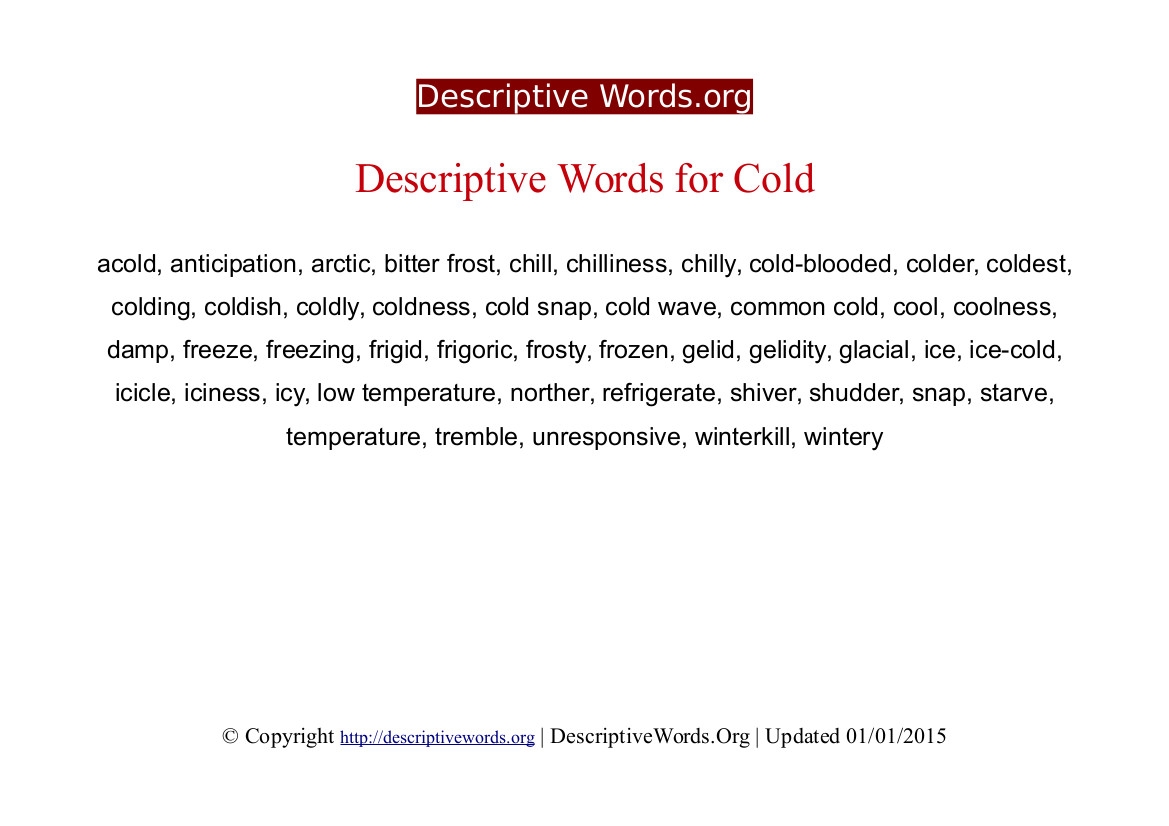
What are some descriptive words for Cold ?
Here is a list of words that describe Cold.
Total number of Cold words and adjectives: 46 words
Cold words are listed in alphabetical order.
anticipation,
arctic,
bitter frost,
chill,
chilliness,
chilly,
cold-blooded,
colder,
coldest,
colding,
coldish,
coldly,
coldness,
cold snap,
cold wave,
common cold,
cool,
coolness,
damp,
freeze,
freezing,
frigid,
frigoric,
frosty,
frozen,
gelid,
gelidity,
glacial,
ice,
ice-cold,
icicle,
iciness,
icy,
low temperature,
norther,
refrigerate,
shiver,
shudder,
snap,
starve,
temperature,
tremble,
unresponsive,
winterkill,
wintery.
Download Cold Words PDF: Descriptive Words for Cold PDF