Describing places is one of the most fundamental and challenging tasks in writing. A well-described place does not merely provide backdrop — it creates atmosphere, reveals character, establishes mood, and can become as important to a story as any person in it. This guide gives you 96 adjectives to describe places, organized by character, atmosphere, and type, with definitions and example sentences for each.
Words for Beautiful and Appealing Places
- Picturesque — visually charming, like a scene from a painting; attractive in a quaint way. “A picturesque village that looked unchanged since the eighteenth century.”
- Scenic — offers attractive natural or built views; visually pleasing. “Scenic in the way of the best coastal roads — every bend a composition.”
- Breathtaking — so beautiful it seems to remove breath; overwhelming in visual impact. “Breathtaking in the literal sense — she stopped on the path and simply could not speak.”
- Magnificent — grand and impressive; beautiful on a large scale. “Magnificent mountain scenery that made every other landscape feel modest.”
- Idyllic — perfect and peaceful; an idealized, beautiful setting. “An idyllic coastal village that bore no relationship to the real economics of fishing.”
- Charming — attractively pleasing; small-scale beauty with personality. “A charming market town that rewarded the detour.”
- Enchanting — delightfully attractive; produces a sense of magic or spell. “Enchanting at dusk — the lanterns lit, the square filling with music.”
- Verdant — richly green with vegetation; lush and growing. “Verdant hillsides that made every photograph look painted.”
- Pristine — perfectly unspoiled; untouched by development or damage. “Pristine wilderness that required four hours of travel to reach and rewarded every one of them.”
- Vibrant — full of life, energy, and color. “A vibrant street market — noise, color, and the smell of a hundred different foods.”
Words for Atmospheric and Moody Places
- Atmospheric — has a strong, distinctive mood that pervades the place. “Atmospheric in the way of places that have seen a great deal and say little about it.”
- Brooding — dark and moody; suggests hidden depths or unease. “Brooding industrial city that wore its history openly.”
- Haunting — memorable in a melancholic or slightly unsettling way. “Haunting in the way of beautiful places where difficult things once happened.”
- Ethereal — delicate and otherworldly; seems not quite of the ordinary world. “Ethereal morning mist over the valley — the landscape suspended between night and day.”
- Mysterious — contains things not fully known or understood; invites curiosity. “Mysterious in the way of ancient places — you felt the weight of what you did not know.”
- Eerie — slightly unsettling in an uncanny way; the familiar made strange. “Eerie in the specific way of an abandoned building still furnished.”
- Melancholic — suffused with gentle sadness; beautiful but sorrowful. “A melancholic beauty to the empty lighthouse.”
- Hushed — very quiet; an oppressive or reverent stillness. “Hushed in the way of libraries and cathedrals — a silence you adopted without being asked.”
Words for Urban and Built Places
- Bustling — full of activity and movement; busy and energetic. “A bustling market district that was impossible to walk quickly through.”
- Vibrant — full of energy, life, and cultural activity. “The most vibrant neighborhood in the city — the one where new things happened first.”
- Cosmopolitan — sophisticated and internationally diverse; at home with the world. “Cosmopolitan in the best sense — the menu was in four languages and the cooks in five.”
- Gritty — rough and urban; authentic working-class energy without polish. “Gritty in a way that was either authentic or off-putting depending on your own history.”
- Historic — contains significant traces of the past; history is visible in the fabric. “Historic in a way that made walking the streets a form of reading.”
- Trendy — fashionable and currently popular; where the interesting people are now. “Trendy in the way that suggested it would be unrecognizable in five years.”
- Run-down — in poor repair; neglected and shabby. “Run-down in a way that had its own beauty once you stopped comparing it to what it had been.”
- Gentrified — renovated and made fashionable, often at the cost of community. “Gentrified in the specific way that left the old businesses but replaced the people.”
Words for Natural Places
- Remote — far from population centers; accessible only with effort. “Remote in a way that required planning to visit and commitment to stay.”
- Isolated — cut off from the rest; surrounded by emptiness or difficulty. “Isolated farmstead on a peninsula that was only accessible at low tide.”
- Wild — untamed and uncultivated; nature without human intervention. “Wild in the sense of landscape that makes its own rules.”
- Rugged — rough and imposing; not soft or cultivated. “Rugged coastline that tourists photographed and locals respected.”
- Serene — deeply peaceful and undisturbed. “Serene in the way of places that have never been in a hurry.”
- Tranquil — free from disturbance; pleasantly quiet. “Tranquil lake that deserved a longer stay than the itinerary allowed.”
- Exposed — open to the elements; wind, weather, and light without shelter. “Exposed hilltop that offered views in every direction and shelter in none.”
Frequently Asked Questions
What are the best adjectives to describe a place?
The most evocative place adjectives combine atmosphere with specific physical quality: ‘a hushed, historic cathedral quarter’ or ‘a vibrant, cosmopolitan harbor.’ In travel and fiction writing, the most powerful place descriptions use a specific detail that carries mood rather than an adjective list: ‘a city where the cafes opened at six and people lingered until midnight’ tells more than ‘a lively, European city.’
What words describe a beautiful place?
For natural beauty: breathtaking, pristine, verdant, serene, and idyllic. For architectural beauty: magnificent, historic, charming, and picturesque. For urban beauty: vibrant, cosmopolitan, and atmospheric. The most specific beautiful-place adjective is often one that describes a very particular quality: ‘luminous’ for a place of extraordinary light; ‘ancient’ for a place where history is physically present.
How do writers describe settings in fiction?
The best fictional settings are described through their effect on the character rather than as independent inventories. A character who notices the smell before the look of a place reveals something about themselves. A setting described as ‘the kind of town where strangers were noticed’ tells us both about the place and its relationship to the character. Use setting to do double work: describe the place and reveal the person observing it simultaneously.
What words describe a scary or unsettling place?
Unsettling places: eerie (uncanny and slightly wrong), brooding (dark and threatening), desolate (empty and lonely), oppressive (weighing down on you), labyrinthine (confusing and inescapable), cavernous (large and echoing), and forbidding (clearly unwelcoming). The most effective scary-place description avoids obvious horror vocabulary and instead makes the ordinary strange: ‘a house where no dust had settled in twenty years.’
What are words to describe a peaceful place?
Peaceful places: serene, tranquil, hushed, still, secluded, sheltered, timeless, and undisturbed. The most specific peaceful-place adjective captures the particular quality of the peace: ‘cathedral-hushed’ for religious silence, ‘becalmed’ for water with no wind, ‘somnolent’ (drowsy and sleepy) for a hot afternoon village. Specific peace words create more vivid images than the generic ‘peaceful.’
What are some descriptive words for Places ?
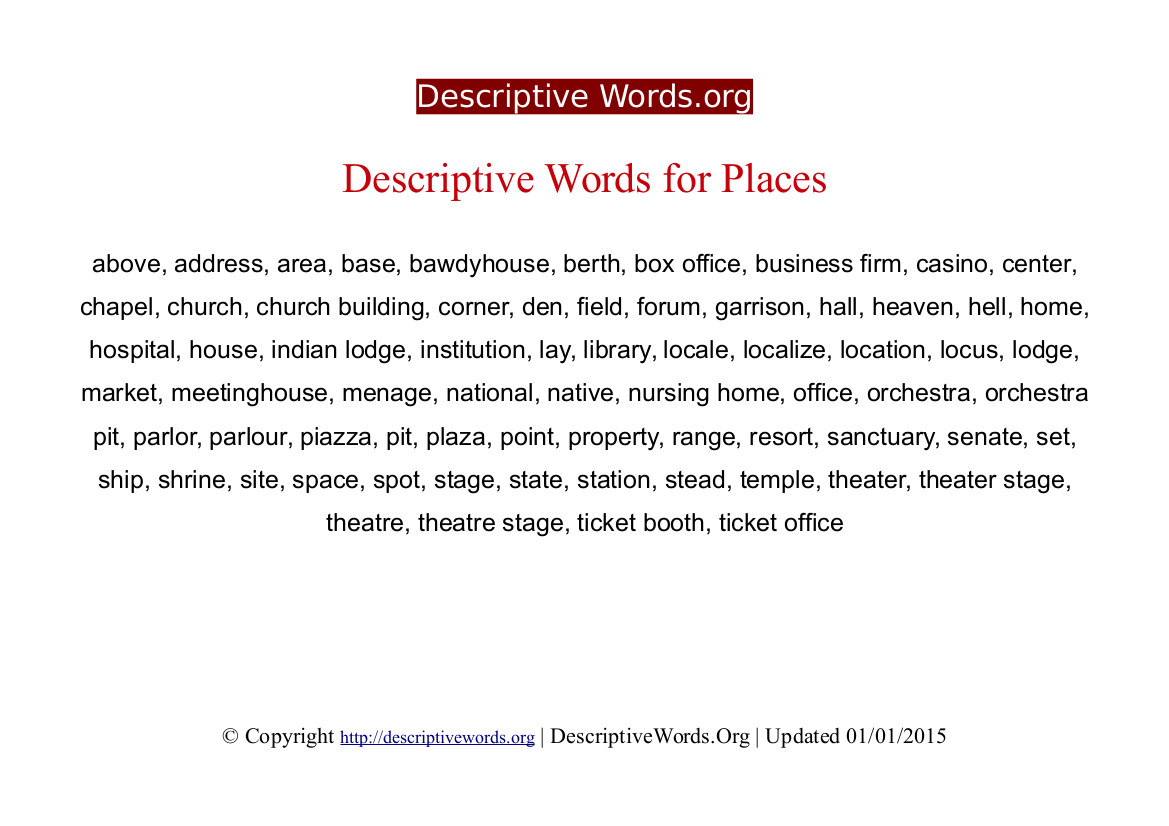
Here is a list of words that describe Places.
Total number of Places words and adjectives: Places 70 words
Places words are listed in alphabetical order.
address,
area,
base,
bawdyhouse,
berth,
box office,
business firm,
casino,
center,
chapel,
church,
church building,
corner,
den,
field,
forum,
garrison,
hall,
heaven,
hell,
home,
hospital,
house,
indian lodge,
institution,
lay,
library,
locale,
localize,
location,
locus,
lodge,
market,
meetinghouse,
menage,
national,
native,
nursing home,
office,
orchestra,
orchestra pit,
parlor,
parlour,
piazza,
pit,
plaza,
point,
property,
range,
resort,
sanctuary,
senate,
set,
ship,
shrine,
site,
space,
spot,
stage,
state,
station,
stead,
temple,
theater,
theater stage,
theatre,
theatre stage,
ticket booth,
ticket office.
Download Places Words PDF: Descriptive Words for Places PDF
hello, thanks for compiling such wonderful words.