Dogs are the most described animals in the English language — from Homer’s Argos waiting twenty years for Odysseus, to Lassie, to the dogs of every generation of literature and film. A precise vocabulary for describing dogs allows writers, dog owners, and animal lovers to capture the specific qualities of individual dogs with accuracy. This guide gives you 80 adjectives for dogs, organized by physical type, temperament, behavior, and energy, with definitions and example sentences.
Physical Description
- Muscular — powerfully built; well-developed musculature. “Muscular Staffie who looked intimidating and was gentle with children.”
- Sleek — smooth-coated and well-proportioned; elegant. “Sleek greyhound built for one purpose and perfect at it.”
- Shaggy — having long, unkempt, or rough fur. “Shaggy sheepdog who had never met a grooming appointment he approved of.”
- Compact — small and solidly built; dense for its size. “Compact Beagle who packed more dog than its dimensions suggested.”
- Barrel-chested — wide and deep in the chest; substantial. “Barrel-chested Rottweiler who had a bark that preceded him by three rooms.”
- Wiry — lean and tough; hidden strength under sparse frame. “Wiry terrier who had energy in exact inverse proportion to his size.”
- Floppy-eared — having ears that hang down; the look of friendliness. “Floppy-eared Spaniel who used his ears as punctuation.”
- Lean — slim and without excess; built for speed or endurance. “Lean Whippet who was all speed and trembling sensitivity.”
Temperament Words
- Loyal — devoted to its people above all else. “Loyal in the complete, unquestioning way that only dogs manage.”
- Gentle — soft and careful in interaction; no aggression. “Gentle giant of a Newfoundland who moved carefully around small things.”
- Affectionate — seeks and gives physical contact; loves being close. “Affectionate Labrador who believed personal space was a human misunderstanding.”
- Protective — naturally guards its people; alert to threats. “Protective German Shepherd who slept with one ear always listening.”
- Timid — easily frightened; needs patient handling. “Timid rescue dog who needed six months to learn the house was safe.”
- Fearless — approaches everything without hesitation. “Fearless Jack Russell who had never assessed a situation before entering it.”
- Aloof — reserved with strangers; not immediately friendly. “Aloof Chow Chow who chose his people carefully and kept the selection small.”
- Sociable — enjoys other dogs and people; actively friendly. “Sociable Labradoodle who treated every stranger as a future best friend.”
Energy and Behavior
- Energetic — high-activity; needs significant exercise. “Energetic Border Collie who needed a job and created one when not provided.”
- Boisterous — exuberantly energetic; enthusiastic and physical. “Boisterous Boxer who greeted everyone as if they had been gone for years.”
- Placid — calm and even-tempered; not easily excited. “Placid Basset Hound who had decided that urgency was rarely justified.”
- Eager — enthusiastic and keen; wants to please. “Eager to learn — the kind of dog that makes training a pleasure.”
- Tenacious — does not give up; follows something to its conclusion. “Tenacious Beagle on a scent — deaf to all other information.”
- Inquisitive — explores everything; driven by smell and curiosity. “Inquisitive nose that investigated every inch of the park independently.”
- Devoted — follows its owner; constant companionship. “Devoted shadow who regarded separation as a clerical error.”
- Stubborn — has its own ideas about what to do. “Stubborn Dachshund who had decided and was not interested in alternative proposals.”
Frequently Asked Questions
What are the best adjectives to describe a dog?
For physical description: muscular, sleek, shaggy, compact, lean, and wiry. For temperament: loyal, gentle, affectionate, protective, and sociable. For energy: energetic, boisterous, placid, and eager. The most vivid dog descriptions combine breed-specific physical vocabulary with a specific behavioral observation: ‘a sleek, devoted greyhound who had given up speed for proximity’ creates a specific and real animal.
What words describe a friendly dog?
Friendly dog vocabulary: sociable (actively seeks contact), affectionate (gives and receives warmth), gentle (soft and careful), eager (keen to please), playful (loves games and interaction), exuberant (overflowing with enthusiasm), devoted (constant in attention), and waggy (informal: expressive with tail). The most important friendly-dog adjective is ‘gentle’ — it implies not just friendliness but control of physical strength, which is the more meaningful quality.
What words describe a loyal dog?
Loyal dog vocabulary: devoted (follows its person completely), steadfast (constant through all circumstances), faithful (true and constant in affection), protective (guards its people), attentive (always aware of its owner’s state), vigilant (watchful on their behalf), and bonded (connected through deep attachment). ‘Devoted’ is the most specific loyalty word for dogs — it implies not just loyalty but active, constant demonstration of it.
How do writers describe dogs in fiction?
The most memorable fictional dogs are described through what they do rather than how they look. Buck in The Call of the Wild is described through his increasing physical power and decreasing civilization. Argos in The Odyssey is described through one action — recognizing Odysseus after twenty years and then dying. The best fictional dog description focuses on the dog’s relationship with its person: the specific way a dog chooses to be near someone tells us about both.
What are words for a well-trained dog?
Well-trained dog vocabulary: obedient (follows commands reliably), responsive (reacts promptly to direction), focused (maintains attention on the handler), composed (calm under distraction), controlled (manages its own impulses), reliable (predictably consistent in behavior), and disciplined (has internalized expected behavior). The difference between ‘trained’ and ‘disciplined’ is important: trained implies external control; disciplined implies the dog has internalized the expectation and follows it independently.
Dogs are the most described animals in human language — our oldest animal companions, subjects of literature from Homer to Jack London, and the focus of more affection than perhaps any other creature on earth. Yet we often default to a small vocabulary when describing them. This guide gives you 81 adjectives to describe dogs, organized by appearance, personality, behavior, and breed qualities, with definitions and example sentences that capture the full richness of canine character.
Words for a Dog's Appearance
Body and Build
- Muscular — powerfully built with visible strength; working dogs, terriers, and working breeds. “A muscular Staffordshire Bull Terrier who generated more force per kilogram than almost any other breed.”
- Lean — slim and without excess weight; sighthounds and working dogs at peak condition. “A lean, angular Greyhound built entirely around speed.”
- Stocky — low and broad with a solid frame; Bulldogs, Basset Hounds, Dachshunds. “Stocky and determined, he covered ground with a rolling, purposeful gait.”
- Lanky — tall with long, slightly ungainly limbs; adolescent dogs often pass through this phase. “A lanky Labrador puppy who had not yet grown into his own feet.”
- Barrel-chested — with a deep, wide chest; Boxers, Bull Mastiffs, and working retrievers. “A barrel-chested Boxer who breathed in great audible gusts.”
- Compact — small but solidly and efficiently built; Pugs, French Bulldogs, Jack Russells. “Compact and self-contained, the terrier needed less space than you would ever guess from the noise.”
Coat and Color
- Shaggy — long, unkempt, and pleasantly disordered hair. “A shaggy Old English Sheepdog who looked like a moving haystack with eyes.”
- Silky — long, smooth, and fine-textured; Setters, Spaniels, Afghan Hounds. “Silky ears that pooled on the floor when she put her head down.”
- Wiry — rough and springy coat, the result of a double-coat structure. “A wiry Welsh Terrier coat that repelled water and most debris.”
- Sleek — short and close-fitting; Dobermanns, Vizslas, Weimaraners. “A sleek, copper-brown coat that showed every line of the muscles beneath.”
- Brindle — a streaked tiger-stripe pattern of dark and light. “A brindle coat that made him look like a small, cheerful tiger.”
- Merle — mottled patches of grey, black, and sometimes blue; Collies, Australian Shepherds. “A merle coat like a watercolor painting that never quite resolved.”
- Sable — dark-tipped hairs on a lighter background; a wolf-like coloring. “A sable German Shepherd who looked like she had walked out of a forest.”
Words for a Dog's Personality
- Loyal — maintains a constant bond with its person or pack; the defining canine virtue. “Loyal in the unconditional way that humans spend their lives trying to achieve with each other.”
- Affectionate — seeks and gives physical warmth freely; leans, licks, and lays its head. “Affectionate to the point of becoming an inconvenience, especially when working from home.”
- Playful — maintains a spirit of play regardless of age; brings toys, invites chase, initiates wrestling. “Playful at twelve years old — slower but no less enthusiastic about the game.”
- Gentle — handles people and animals with care; a soft mouth, soft paws, soft approach. “Gentle with the baby in a way that seemed deliberate and considered.”
- Exuberant — overflows with enthusiasm and energy; everything is exciting, everything is wonderful. “Exuberant in the way that makes it impossible to come home without smiling.”
- Stoic — tolerates discomfort, noise, and difficulty without complaint. “Stoic through the fireworks in a way that made his owners feel slightly inadequate.”
- Curious — investigates everything; nose first, questions later. “Curious to a degree that created significant domestic hazards.”
- Independent — does not need constant reassurance; comfortable in its own company. “Independent by nature — she would choose her nap over companionship without apology.”
- Sensitive — reads emotional cues acutely; responds to shifts in human mood. “Sensitive enough to know when to push in for comfort and when to stay at a respectful distance.”
- Stubborn — knows its own mind and is reluctant to change it; Basset Hounds, Beagles, Huskies. “Stubborn in the way that only a Beagle following a scent can truly be stubborn.”
Words for a Dog's Behavior
- Energetic — in near-constant motion; needs significant daily exercise. “An energetic Border Collie who needed a job, not a sofa.”
- Boisterous — noisily enthusiastic; knocks things over, creates physical chaos through joy. “A boisterous young Labrador for whom furniture was merely an obstacle.”
- Docile — calm, compliant, and easy to manage; never challenges or resists. “Docile and easy — the ideal first dog for a family learning what they're doing.”
- Alert — watchful and responsive; notices everything and misses nothing. “Alert at the first sound, on her feet at the second.”
- Protective — instinctively guards its people and territory. “Protective without being aggressive — she knew the difference.”
- Eager-to-please — works hard to satisfy its owner; the foundation of trainability. “Eager-to-please in a way that made training a pleasure rather than a battle.”
- Mischievous — inventive in finding trouble; not malicious, just creative. “Mischievous in the specific way of dogs who are intelligent and under-stimulated.”
- Sociable — gets along with other dogs and people; greets strangers with enthusiasm. “So sociable that a walk of any length required the better part of an afternoon.”
Words for Specific Dog Types and Roles
- Tenacious — does not let go; terriers and working dogs. “Tenacious in the pursuit of a ball, a scent, or a grudge.”
- Tireless — maintains energy across long working days; working breeds. “Tireless over terrain that finished the humans in half the time.”
- Courageous — faces threats without hesitation; police dogs, rescue dogs, guarding breeds. “Courageous in a calm, matter-of-fact way — not reckless, just fearless.”
- Intuitive — reads and responds to emotional or situational cues without being taught. “Intuitive in the way of therapy dogs — she always went to the one person in the room who needed her most.”
- Devoted — profoundly attached to one person or family; the deepest form of dog loyalty. “Devoted in the way that outlasted every change of circumstance.”
Frequently Asked Questions
What are the best adjectives to describe a dog?
The most evocative dog descriptions combine appearance with personality: ‘a sleek, alert Weimaraner’ or ‘a shaggy, exuberant Goldendoodle.’ The most meaningful single adjectives are loyal, affectionate, gentle, and playful — the four qualities that make dogs uniquely suited to human companionship.
What words describe a good family dog?
A good family dog is described as: gentle, sociable, patient, docile, affectionate, and tolerant. Breed-specific recommendations often include these adjectives: Golden Retrievers are ‘devoted and gentle,’ Labradors ‘exuberant and loyal,’ Cavalier King Charles Spaniels ‘tender and adaptable.’ Tolerance of children’s noise and unpredictability is captured by ‘patient’ and ‘stoic.’
What words describe an aggressive dog?
An aggressive dog may be described as: reactive (over-responds to stimuli), territorial (guards space aggressively), dominant (challenges authority), fearful-aggressive (attacks out of fear), and protective-aggressive (defends perceived threats to owner). Note that ‘aggressive’ is often a symptom of fear or poor socialization rather than a fixed personality trait.
What are poetic or literary words for a dog?
‘Faithful’ is the most classical literary adjective — from Argos in the Odyssey onward. ‘Steadfast,’ ‘devoted,’ ‘dauntless’ (fearless), and ‘companionable’ are beautiful literary choices. Jack London’s wolf-dog descriptions use ‘primordial,’ ‘elemental,’ and ‘untamed’ for dogs close to their wild nature.
How do you describe a dog’s eyes?
Dog eyes are most commonly described as: soulful (deep and seemingly understanding), liquid (soft and glowing), intelligent (alert and evaluating), trusting (open and unguarded), expressive (showing readable emotion), and mournful (the famous sad-dog look, often used manipulatively). The eyes are where the emotional vocabulary of dogs is concentrated.
What are some descriptive words for Dogs ?
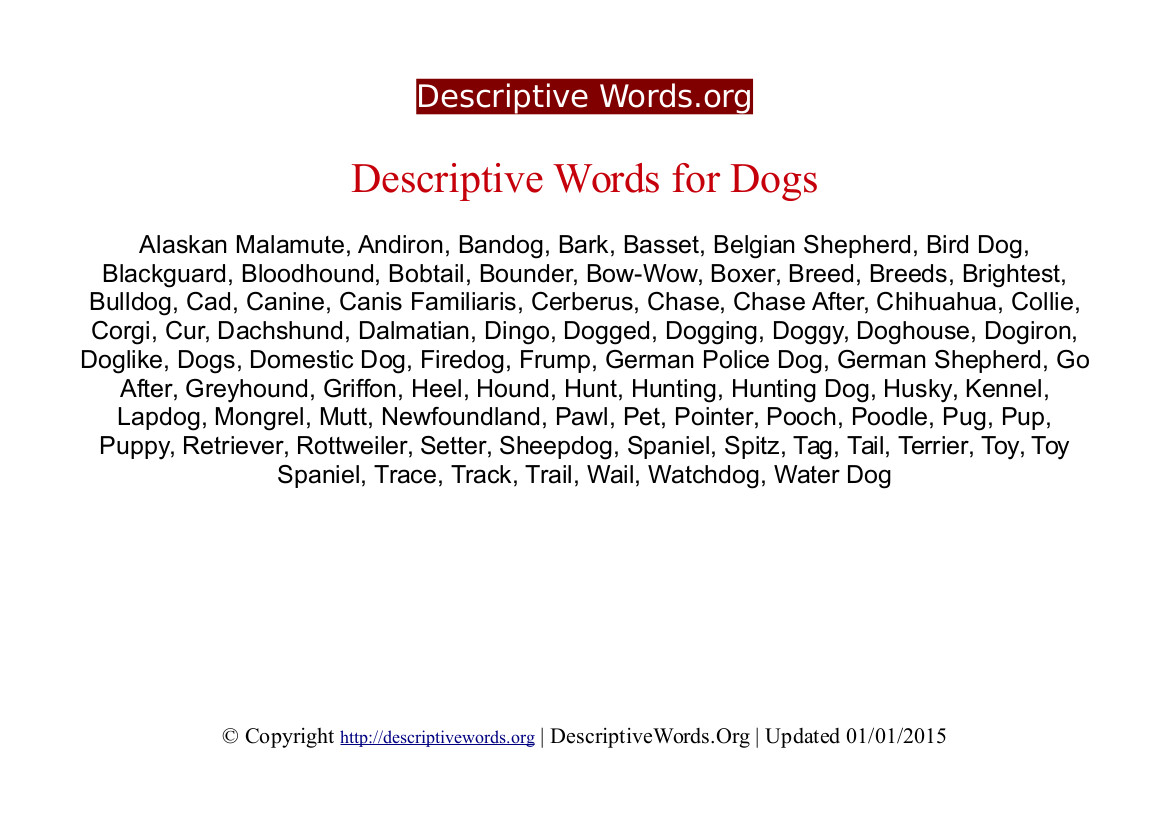
Here is a list of words that describe Dogs.
Total number of Dogs words and adjectives: 81 words
Dogs words are listed in alphabetical order.
Andiron,
Bandog,
Bark,
Basset,
Belgian Shepherd,
Bird Dog,
Blackguard,
Bloodhound,
Bobtail,
Bounder,
Bow-Wow,
Boxer,
Breed,
Breeds,
Brightest,
Bulldog,
Cad,
Canine,
Canis Familiaris,
Cerberus,
Chase,
Chase After,
Chihuahua,
Collie,
Corgi,
Cur,
Dachshund,
Dalmatian,
Dingo,
Dogged,
Dogging,
Doggy,
Doghouse,
Dogiron,
Doglike,
Dogs,
Domestic Dog,
Firedog,
Frump,
German Police Dog,
German Shepherd,
Go After,
Greyhound,
Griffon,
Heel,
Hound,
Hunt,
Hunting,
Hunting Dog,
Husky,
Kennel,
Lapdog,
Mongrel,
Mutt,
Newfoundland,
Pawl,
Pet,
Pointer,
Pooch,
Poodle,
Pug,
Pup,
Puppy,
Retriever,
Rottweiler,
Setter,
Sheepdog,
Spaniel,
Spitz,
Tag,
Tail,
Terrier,
Toy,
Toy Spaniel,
Trace,
Track,
Trail,
Wail,
Watchdog,
Water Dog.
Download Dogs Words PDF: Descriptive Words for Dogs PDF