Describing someone's appearance is one of the most common writing tasks — and one of the most frequently done poorly. Generic adjectives like “pretty,” “tall,” or “attractive” tell the reader almost nothing. The English language has a rich vocabulary for human appearance that goes far beyond these basics — words that capture not just what a person looks like but how they carry themselves, how they present to the world, and what their appearance reveals about their character and life. This guide gives you 90+ adjectives to describe appearance, with definitions and example sentences.
Words for General Attractive Appearance
- Striking — immediately and memorably attractive; makes a strong impression. “Striking in a way that had nothing to do with conventional beauty.”
- Arresting — captures and holds attention; cannot be looked away from easily. “An arresting face that the camera loved from any angle.”
- Handsome — attractive in a well-proportioned, strong way; traditionally masculine but now used broadly. “Handsome in an understated way — the kind that improved with attention.”
- Radiant — glowing with health or happiness; beauty that seems lit from within. “Radiant in the way of someone who has just had very good news.”
- Magnetic — draws attention irresistibly; a charismatic physical presence. “Magnetic — not conventionally attractive but impossible to not watch.”
- Distinguished — impressive and authoritative in appearance; especially of older people. “Distinguished in the way of good bone structure and silver hair.”
- Luminous — seems to generate its own light; glowing with vitality. “Luminous skin that made makeup seem beside the point.”
Words for Body Build and Physique
- Athletic — fit and well-muscled; a body shaped by physical activity. “Athletic in the way of someone who works with their body rather than in a gym.”
- Willowy — tall and slender with graceful proportions. “Willowy in a way that made movement look effortless.”
- Statuesque — tall, beautifully proportioned, and commanding. “Statuesque — she made every room feel slightly smaller.”
- Lithe — slim and moving with fluid ease; supple. “Lithe and quick-moving — the economy of the natural athlete.”
- Stocky — solidly built; broad and compact. “Stocky with a low center of gravity that served him well in most situations.”
- Slight — slender and small; not physically imposing. “Slight in build but not in presence — she occupied a room fully.”
- Wiry — lean but visibly strong; the musculature of the endurance athlete. “Wiry and deceptively strong.”
- Portly — round and somewhat overweight; often used with dignity. “A portly figure who moved with surprising lightness.”
Words for Bearing and Posture
- Poised — beautifully balanced and composed; controlled without being stiff. “Poised in a way that suggested both confidence and physical awareness.”
- Erect — standing straight and tall; upright and formal in bearing. “Erect despite his age — military discipline that outlasted military service.”
- Languid — slow-moving and relaxed; a quality of ease in every movement. “Languid in her movements — everything unhurried, everything deliberate.”
- Graceful — moving with smooth, effortless elegance. “Graceful in the way that made people stop conversations to watch.”
- Commanding — carries an authority that others respond to without being asked. “Commanding even at rest — the room oriented toward her.”
- Diffident — shy in bearing; takes up as little space as possible. “Diffident in the way of someone overlooked so often they had begun to cooperate with it.”
- Slouched — hunched forward; suggests defeat or self-consciousness. “Slouched in a way that made him look shorter than he was.”
Words for Age and the Marks of Time
- Youthful — appears younger than their age; fresh and energetic in aspect. “Youthful at sixty in the way that comes from genuinely enjoying life.”
- Weathered — marked by outdoor exposure; lined and leathered by sun and wind. “Weathered in the way of people who spend their lives outside.”
- Careworn — showing the visible strain of worry and responsibility. “Careworn in a way that the promotion had accelerated.”
- Haggard — gaunt and exhausted; drawn by illness, grief, or deprivation. “Haggard after the crossing — three days without sleep or warmth.”
- Vigorous — full of physical energy and health; robust. “Vigorous at seventy-five in a way that made younger people reconsider their habits.”
- Timeworn — showing the effects of age gracefully; dignified wear. “A timeworn face of great character.”
Words for Grooming and Presentation
- Immaculate — perfectly clean and ordered; every detail attended to. “Immaculate in a way that took either great effort or natural fastidiousness.”
- Polished — well-groomed and presented with care; professional finish. “Polished in appearance without being flashy.”
- Dapper — neatly and stylishly dressed; smart and trim. “Dapper in his pocket square and precisely knotted tie.”
- Disheveled — untidy; clothing and hair not in order. “Disheveled but somehow compelling — the disarray of a person too busy thinking to notice.”
- Unkempt — not cared for; neglected in presentation. “Unkempt in the way that suggests preoccupation rather than indifference.”
- Slovenly — untidy and careless in dress; negative. “Slovenly in a way that communicated contempt for the occasion.”
Frequently Asked Questions
What are the best adjectives to describe someone’s appearance?
The most useful appearance adjectives combine physical description with bearing: ‘striking and poised’ tells more than simply ‘attractive.’ In writing, the most powerful descriptions focus on bearing, expression, and the marks of lived experience. ‘Weathered,’ ‘careworn,’ ‘radiant,’ and ‘commanding’ each contain a story.
How do you describe someone’s appearance without being cliche?
Avoid the feature-by-feature inventory that reads like a police report. Instead: describe one or two specific unusual details; describe the impression the person creates; describe how others react; focus on bearing and movement. ‘She entered a room and people straightened’ tells more than a paragraph of physical description.
What are words to describe an elegant appearance?
Elegant appearance: poised, immaculate, statuesque, graceful, distinguished, refined, willowy, and polished. Elegance is about proportion, bearing, and the economy of style — described through what is absent: no excess, no effort visible, nothing wasted.
What are words to describe a rugged appearance?
Rugged appearance: weathered, chiseled (strong defined features), angular, craggy (rough-hewn), square-jawed, athletic, and broad-shouldered. ‘Craggy’ is particularly strong — it implies a roughness that has its own impressive quality, like a cliff face.
How do authors describe physical appearance in fiction?
The best fiction writers describe appearance economically and purposefully. Every physical detail should carry character information. ‘Immaculate’ in a difficult scene tells us about a character’s need for control; ‘haggard’ tells us how much the situation is costing them. Let appearance description do double duty.
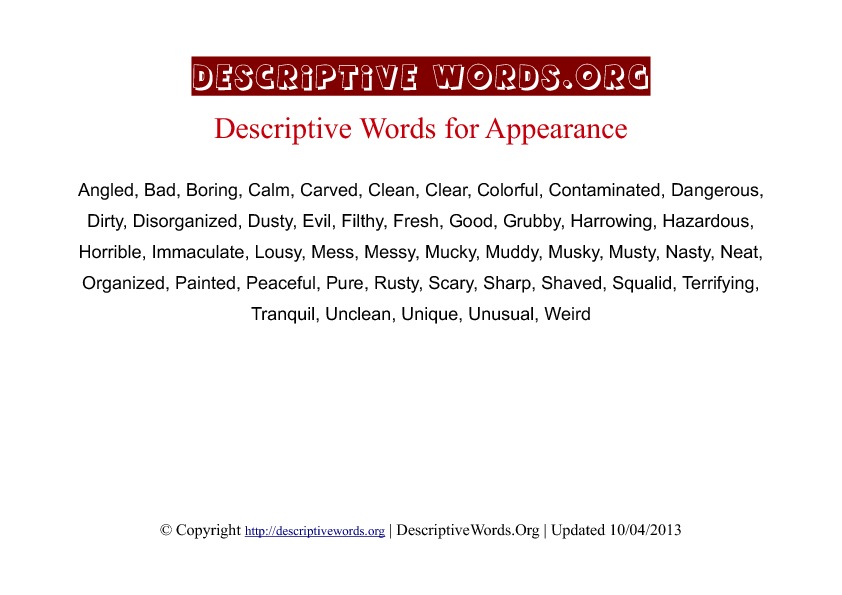
What are some descriptive words for Appearance ?
Here is a list of words that describe Appearance.
Total number of Appearance words and adjectives: 46 words
Appearance words are listed in alphabetical order.
Bad,
Boring,
Calm,
Carved,
Clean,
Clear,
Colorful,
Contaminated,
Dangerous,
Dirty,
Disorganized,
Dusty,
Evil,
Filthy,
Fresh,
Good,
Grubby,
Harrowing,
Hazardous,
Horrible,
Immaculate,
Lousy,
Mess,
Messy,
Mucky,
Muddy,
Musky,
Musty,
Nasty,
Neat,
Organized,
Painted,
Peaceful,
Pure,
Rusty,
Scary,
Sharp,
Shaved,
Squalid,
Terrifying,
Tranquil,
Unclean,
Unique,
Unusual,
Weird.