The words you use to describe a house tell the reader as much about the people living in it as they do about the building itself. A rambling Victorian says something different from a trim bungalow. A crumbling farmhouse is not the same story as a weathered one, even if they look the same from the road. The right adjective does double work: it describes the physical structure and implies the life inside.
Descriptive Words for Houses: Quick Reference
| Category | Words |
|---|---|
| Size and scale | grand, imposing, sprawling, rambling, modest, compact, cramped, towering, squat |
| Good condition | immaculate, pristine, well-maintained, solid, sturdy, restored |
| Poor condition | dilapidated, crumbling, run-down, neglected, derelict, weathered, sagging |
| Style | Victorian, colonial, Georgian, rustic, modern, minimalist, ornate, austere |
| Atmosphere | welcoming, forbidding, cheerful, gloomy, cozy, cold, lived-in |
Words for Size and Scale
Grand — Impressively large and formal; designed to make an impression.
The grand house sat at the end of a long gravel drive lined with chestnut trees.
Imposing — Large and commanding enough to inspire awe or mild intimidation.
The imposing brick facade gave no hint of what the interior was like.
Sprawling — Spreading over a large, irregular area; added to in stages over time.
The sprawling farmhouse had been extended so many times it was impossible to find the original structure.
Rambling — Large and irregular in layout; rooms that seem to have no clear plan.
They spent the first week just getting lost in the rambling old house.
Modest — Unpretentious and appropriately sized; neither too large nor too small.
It was a modest house on a quiet street, which was exactly what they had been looking for.
Compact — Small but efficient; everything in its place with no wasted space.
The compact terrace had been renovated to feel twice its actual size.
Cramped — Too small for its purpose; confined and uncomfortable.
The family of five lived in a cramped two-bedroom flat for three years before they could afford to move.
Squat — Low and wide, close to the ground; suggests solidity without elegance.
The squat stone building had stood in that field for four centuries and showed no signs of moving.
Words for Good Condition
Immaculate — Perfectly clean and maintained; no fault to be found.
The immaculate white facade stood out among its neighbors like something transplanted from another postcode.
Pristine — As good as new; untouched or perfectly preserved.
The interior was pristine, as if no one had actually lived there but only visited.
Solid — Structurally sound; dependable rather than decorative.
The solid Victorian terrace had survived two wars and three decades of student tenants.
Restored — Brought back to its original condition after damage or deterioration.
The restored Georgian townhouse retained the original cornicing and fireplaces throughout.
Words for Poor Condition
Dilapidated — In a serious state of disrepair through age or neglect.
The dilapidated cottage had charm, which was a generous word for structural problems.
Crumbling — Actively deteriorating; losing material and structural integrity.
The crumbling plasterwork in the hallway came off in your hand if you weren’t careful.
Weathered — Worn by exposure to the elements; suggests age rather than neglect.
The weathered stone walls had a particular grey-gold color that no paint ever quite matched.
Neglected — Not given adequate maintenance; suffering from sustained inattention.
The neglected garden had become so overgrown that the path to the door was no longer obvious.
Sagging — Drooping under weight or age; structural elements giving way slowly.
The sagging roofline was the first thing the surveyor photographed.
Words for Atmosphere
Welcoming — Warm and inviting; makes visitors feel comfortable immediately.
The welcoming front garden: window boxes, a mat, lights on inside.
Forbidding — Cold or threatening in appearance; does not invite approach.
The forbidding iron gate and high hedges made the house invisible from the road.
Cozy — Small, warm, and comfortable; intimate rather than cramped.
The cozy sitting room had a fireplace, a window seat, and not quite enough bookshelves.
Lived-in — Showing the comfortable evidence of real use; not staged or showroom-perfect.
The kitchen was lived-in: a stack of mail, a child’s drawing on the fridge, two mugs drying by the sink.
Gloomy — Dark and dispiriting; lacking light or warmth.
The gloomy north-facing rooms had never got the sun and showed it in the peeling paint.
Example Sentences
The rambling country house had so many corridors that guests needed a floor plan to find the bathroom.
She stood on the pavement outside the dilapidated terrace and tried to picture what it had looked like in 1900.
The imposing gate opened automatically as they approached, which was either impressive or unsettling.
The lived-in quality was what sold them on it: the scuff marks, the worn patch on the kitchen floor, the evidence of a life well spent inside those walls.
Frequently Asked Questions
What is a word for a large, impressive house?
Grand and imposing both work. Grand suggests scale and formality. Imposing suggests the psychological effect on the viewer. Sprawling is good for houses that extend over ground rather than rising up.
What words describe an old, run-down house?
Dilapidated is the strongest option. Crumbling is more active. Neglected assigns a reason. Weathered is more sympathetic: worn by time rather than by failure of care.
What word describes a house that feels warm and welcoming?
Cozy is the classic choice for small, warm spaces. Welcoming is better for the exterior impression. Lived-in is the most specific: it implies genuine habitation rather than staged comfort.
Related Word Lists
Describing a house requires vocabulary that captures architecture, atmosphere, condition, size, style, and the emotional experience of the space. Whether writing real estate listings, fiction, travel writing, or property journalism, a precise house vocabulary creates vivid and accurate descriptions. This guide gives you 70 adjectives for houses, organized by size, style, condition, and atmosphere, with definitions and example sentences.
Words for House Size and Scale
- Spacious — having generous room; not cramped. “Spacious living room that had survived every attempt to fill it.”
- Compact — small but efficiently designed; no wasted space. “Compact terraced house that had room for everything necessary.”
- Grand — impressively large and imposing. “Grand Victorian facade that dwarfed every expectation.”
- Modest — not large or showy; appropriately sized. “Modest bungalow that suited the life lived in it.”
- Sprawling — spreading over a large area, often irregularly. “Sprawling farmhouse added to over three generations.”
- Intimate — small and cozy; creates a sense of closeness. “Intimate cottage that felt like being held.”
Words for House Condition
- Pristine — in perfect condition; immaculate. “Pristine new-build that still smelled of paint and possibility.”
- Dilapidated — in poor condition through neglect or age. “Dilapidated Victorian terrace that needed everything.”
- Renovated — restored and updated; combining old structure and new finish. “Renovated Georgian townhouse where the bones were original and everything else was new.”
- Weathered — showing the marks of age and exposure. “Weathered stone exterior that communicated permanence.”
- Well-maintained — consistently cared for; in good repair. “Well-maintained semi that had been lived in carefully.”
- Neglected — insufficiently cared for; showing the effects. “Neglected garden that had its own ideas about what it wanted to be.”
Words for House Atmosphere and Character
- Cozy — warm and comfortable; inviting and sheltered. “Cozy in winter — the specific pleasure of inside when outside is impossible.”
- Welcoming — makes visitors feel at ease; warm and hospitable. “Welcoming in the specific way of houses that have been happy.”
- Characterful — full of interesting features and personality. “Characterful period property with original features intact.”
- Charming — delightfully attractive; has an appealing quality. “Charming in the estate agent sense, which required translation.”
- Austere — severe and plain; minimal ornamentation. “Austere modernist house where the architecture was the decoration.”
- Imposing — grand and commanding; makes an impression. “Imposing entrance that prepared visitors for a serious interior.”
- Homely — comfortable and homelike; unpretentious. “Homely in the British sense — comfortable, warm, not designed to impress.”
Frequently Asked Questions
What are the best adjectives to describe a house?
For size: spacious, compact, grand, modest, sprawling, and intimate. For condition: pristine, dilapidated, renovated, weathered, and well-maintained. For atmosphere: cozy, welcoming, characterful, charming, austere, and imposing. The most useful house description combines size, condition, and atmosphere: ‘a compact, well-maintained Victorian terrace with a characterful interior’ conveys the essential property information in eleven words.
What words describe a beautiful house?
Beautiful house vocabulary: elegant (refined and graceful), stunning (immediately impressive), charming (delightfully attractive), handsome (well-proportioned and attractive), imposing (grand and commanding), picturesque (looks like a picture), quaint (attractively old-fashioned), and magnificent (impressively beautiful). ‘Handsome’ is the most architectural of these — it describes beauty of proportion rather than decoration, which is the most lasting quality in a building.
What words describe an old or historic house?
Historic house vocabulary: period (from a specific architectural era), original (retaining features from when it was built), historic (of historical significance), ancient (of great age), vernacular (using local building traditions and materials), Grade I/II listed (UK designation for buildings of special architectural or historic interest), and heritage (part of a cultural or historical tradition). ‘Vernacular’ is the most architectural term — it describes buildings that use local materials and traditional methods without formal architectural design.
How do writers describe houses in fiction?
Houses in fiction function as character — they reveal who lives in them and what has happened there. Manderley in ‘Rebecca’ is a character as much as any person. The technique: describe a house through its effect on the character who enters it, and through specific details that accumulate meaning: ‘the door that had never been painted,’ ‘the window that showed the same view for twenty years,’ ‘the smell of a house that had been a home.’ What a house retains tells us what its occupants valued.
What real estate words describe a desirable house?
Desirable house vocabulary: turnkey (ready to move into without work), well-appointed (furnished or equipped to a high standard), light-filled (has abundant natural light), open-plan (few internal walls, connected spaces), period (from an architecturally valuable era), sought-after (in high demand), and prime location (in the most desirable area). Estate agent language is its own genre — ‘cozy’ means small, ‘characterful’ means quirky, ‘potential’ means needs work. The vocabulary between buyer and seller is always a negotiation.
What are some descriptive words for Houses?
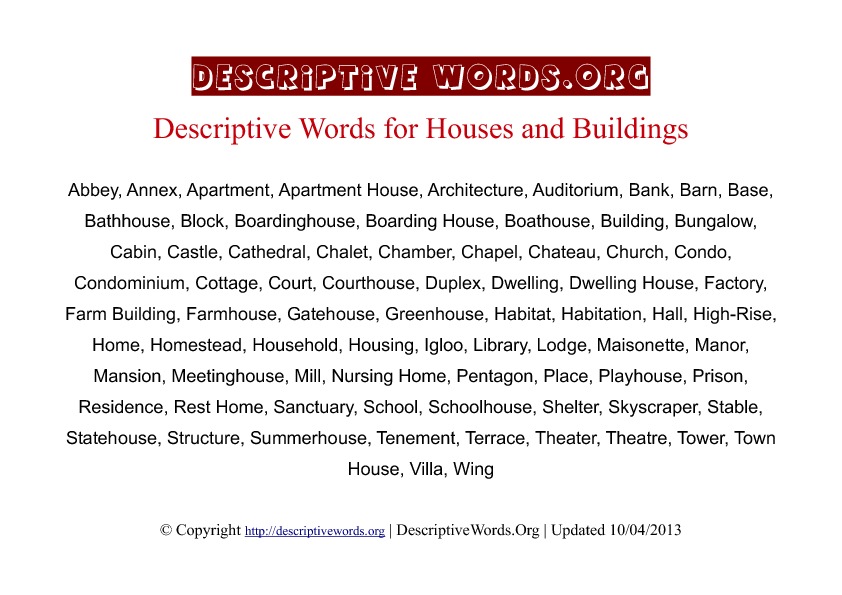
Here is a list of words that describe Houses and dwellings.
Total number of Houses words and adjectives: 77 words
House words are listed in alphabetical order.
Annex,
Apartment,
Apartment House,
Architecture,
Auditorium,
Bank,
Barn,
Base,
Bathhouse,
Block,
Boardinghouse,
Boarding House,
Boathouse,
Building,
Bungalow,
Cabin,
Castle,
Cathedral,
Chalet,
Chamber,
Chapel,
Chateau,
Church,
Condo,
Condominium,
Cottage,
Court,
Courthouse,
Duplex,
Dwelling,
Dwelling House,
Factory,
Farm Building,
Farmhouse,
Gatehouse,
Greenhouse,
Habitat,
Habitation,
Hall,
High-Rise,
Home,
Homestead,
Household,
Housing,
Igloo,
Library,
Lodge,
Maisonette,
Manor,
Mansion,
Meetinghouse,
Mill,
Nursing Home,
Pentagon,
Place,
Playhouse,
Prison,
Residence,
Rest Home,
Sanctuary,
School,
Schoolhouse,
Shelter,
Skyscraper,
Stable,
Statehouse,
Structure,
Summerhouse,
Tenement,
Terrace,
Theater,
Theatre,
Tower,
Town House,
Villa,
Wing
Download Words for Houses in PDF: Descriptive Words for Houses PDF