The concept of help is one of the most fundamental in human social life — and the vocabulary for describing helpful people, helpful actions, and the quality of assistance is both extensive and precise. Whether you are writing a recommendation, a description of a colleague, a piece of fiction, or a reflection on gratitude, a rich help vocabulary allows you to distinguish between different types and qualities of assistance. This guide gives you 75 adjectives for help and helpfulness, with definitions and example sentences.
Words for People Who Help
- Helpful — ready and willing to assist; makes things easier. “Helpful in the specific way of people who identify what is needed before being asked.”
- Supportive — provides encouragement and assistance through difficulty. “Supportive in a way that made failure feel like information rather than verdict.”
- Generous — gives freely of time, knowledge, and resources. “Generous with expertise that most people in her position would have protected.”
- Accommodating — willing to adjust to others’ needs. “Accommodating without compromising — the rare combination.”
- Cooperative — works well with others toward shared goals. “Cooperative in a way that made the project feel collectively owned.”
- Selfless — puts others’ needs before their own without calculation. “Selfless help that asked nothing in return and received gratitude anyway.”
- Devoted — committed to the service of others. “Devoted to the work in a way that made the hours invisible.”
- Attentive — notices and responds to needs without being asked. “Attentive in the way of people who pay attention to more than what is said.”
- Willing — ready to help without reluctance. “Willing to stay late without the performance of reluctance.”
- Proactive — anticipates needs and acts before being asked. “Proactive help that arrived before the problem was fully visible.”
Words for the Quality of Assistance
- Practical — dealing with actual needs; concrete and useful. “Practical help rather than sympathy — which was exactly what was needed.”
- Effective — produces the desired result; actually works. “Effective intervention that changed the outcome rather than just acknowledging the problem.”
- Timely — arrives at the right moment; not too early or too late. “Timely assistance that found the problem before it became a crisis.”
- Invaluable — too useful to be measured; essential. “Invaluable guidance at a point when the alternatives were all worse.”
- Constructive — builds toward a solution; not just identifying problems. “Constructive feedback that left the recipient with more than they arrived with.”
- Meaningful — makes a real difference; not superficial. “Meaningful help rather than the appearance of it — the rarer kind.”
- Substantial — significant in amount or effect; not token. “Substantial contribution that changed the project’s trajectory.”
- Indispensable — absolutely necessary; cannot be done without. “Indispensable in the real sense — the project would not have completed without them.”
Words for Unhelpful Behavior
- Unhelpful — does not assist; may even make things harder. “Unhelpful response that answered the question without addressing the problem.”
- Obstructive — actively blocks progress or assistance. “Obstructive in the specific way of bureaucracy that has forgotten its purpose.”
- Indifferent — does not care about others’ needs. “Indifferent in a position that required the opposite.”
- Reluctant — unwilling; helps only when required. “Reluctant help that communicated its own resentment.”
- Ineffective — does not produce the desired result. “Ineffective intervention that satisfied the helper more than it helped the recipient.”
Frequently Asked Questions
What are the best adjectives to describe a helpful person?
For willingness: helpful, supportive, generous, accommodating, cooperative, and willing. For the quality of help: practical, effective, timely, invaluable, and constructive. For character: selfless, devoted, attentive, and proactive. The most specific helpful-person adjective is ‘proactive’ — it describes help that arrives before it is requested, which is the highest form of assistance because it requires the helper to notice what others have not yet articulated.
What words describe useful or valuable help?
Valuable help vocabulary: invaluable (too useful to measure), indispensable (cannot be done without), essential (fundamental and necessary), practical (concrete and useful), effective (actually works), substantial (significant in amount), meaningful (makes a real difference), and transformative (changes the situation fundamentally). The distinction between ‘helpful’ and ‘invaluable’: helpful describes a quality of the person or action; invaluable describes the measured impact of that help on the situation.
What are words for helping in different contexts?
Context-specific help vocabulary: supportive (emotional help), practical (material or task-based help), educational (help through knowledge transfer), therapeutic (help for psychological recovery), remedial (help to correct a problem), preventive (help that avoids a problem before it occurs), and collaborative (help through working together). The most valuable help is often ‘preventive’ — the problem that never happened because someone noticed and acted early.
How do writers describe helpful characters in fiction?
Helpful characters in fiction are most memorable when their help has a cost — when it requires sacrifice, risk, or going against self-interest. The mentor who helps the hero at personal expense (Gandalf, Dumbledore, Haymitch) is more memorable than the helper who has nothing to lose. The technique: give the helpful character something at stake in the helping. What they risk by helping tells us everything about who they are.
What are words that describe bad or unhelpful assistance?
Unhelpful assistance vocabulary: well-meaning but ineffective (good intention, no result), patronizing (treats the recipient as incapable), obstructive (actively blocks), counterproductive (makes things worse), superficial (does not address the real need), performative (help for appearance rather than effect), and token (minimal, more symbolic than real). ‘Performative help’ is the most useful critical term — it describes assistance that is primarily about the helper appearing helpful rather than the recipient being helped.
The word help appears in an enormous range of contexts — from urgent rescue to quiet support, from practical assistance to emotional encouragement. The English language has developed a rich vocabulary for different kinds and qualities of help, allowing us to describe exactly what kind of assistance is being offered or received. This guide gives you 60+ adjectives and words related to help, with definitions and example sentences organized by type and context.
Types of Help — Core Adjectives
- Invaluable — so helpful it is impossible to put a value on; utterly essential. “Her support during that period was invaluable — I could not have managed without it.”
- Indispensable — absolutely necessary; cannot be done without. “He quickly made himself indispensable to the team.”
- Practical — focused on real, concrete tasks rather than emotional support. “What she needed was practical help — someone to drive, to cook, to make calls.”
- Tangible — help that produces real, visible, measurable results. “The charity focused on tangible help: food, shelter, legal advice.”
- Timely — arriving at exactly the right moment, before it is too late. “The timely intervention of a neighbor prevented a serious accident.”
- Wholehearted — given completely and enthusiastically, without reservation. “She offered her wholehearted support from the very first day.”
- Unconditional — given freely with no strings attached; not contingent on anything in return. “The unconditional support of his parents gave him the confidence to take the risk.”
- Sustained — continuing over a long period without fading. “What the project needed was sustained help, not a single burst of effort.”
Words for the Person Giving Help
- Helpful — ready and willing to assist; the baseline adjective. “The most helpful member of the group was also the quietest.”
- Supportive — providing emotional backing and encouragement, especially during difficulty. “A supportive manager who checked in regularly and never micromanaged.”
- Accommodating — willing to adjust, adapt, and make things easier for others. “The hotel was remarkably accommodating about the last-minute changes.”
- Cooperative — works together willingly; not resistant or obstructive. “A cooperative colleague who made every project easier to manage.”
- Generous — gives more than expected; shares freely of time, knowledge, or resources. “She was generous with her expertise, always willing to teach.”
- Attentive — notices what is needed and responds before being asked. “An attentive assistant who anticipated problems before they arose.”
- Diligent — careful and persistent in providing help; does not cut corners. “A diligent tutor who prepared detailed feedback for every session.”
- Proactive — offers help without waiting to be asked; anticipates needs. “A proactive colleague who spotted the error before it became a crisis.”
- Empathetic — provides help that is emotionally attuned to what the person actually needs. “An empathetic counselor who helped her find her own answers rather than offering ready-made solutions.”
- Resourceful — finds ways to help even when resources are limited. “A resourceful mentor who always found a creative solution.”
Words for the Nature of the Help Itself
- Constructive — help that builds something up; useful and productive. “Constructive feedback that gave her clear directions for improvement.”
- Remedial — help specifically designed to correct a problem or fill a gap. “Remedial support in mathematics helped him catch up with the class.”
- Preventive — help that stops a problem from developing in the first place. “Preventive advice from the accountant saved them from a significant tax penalty.”
- Collaborative — help that works with rather than for someone; joint effort. “The most effective support was collaborative — both sides working toward the same goal.”
- Complementary — help that adds what is missing; fills gaps in existing capability. “Her technical skills were complementary to his creative vision.”
- Specialized — help with a specific, expert focus not available from a general source. “She needed specialized legal help that a general solicitor could not provide.”
Words for Help That Falls Short
- Inadequate — not enough; fails to meet the need. “The help offered was inadequate for the scale of the problem.”
- Superficial — addresses only the surface of the problem without real depth. “The advice was superficial — easy to give, difficult to apply.”
- Well-meaning — intends to help but may not succeed; good intentions without good outcomes. “Well-meaning friends who did not quite know what was actually needed.”
- Reluctant — given unwillingly; the assistance is provided but the spirit is absent. “The help she received was reluctant and came with conditions.”
- Patronizing — help that implies the receiver is incapable; condescending in its delivery. “The offer of help, well-intentioned as it was, felt patronizing.”
Frequently Asked Questions
What is a stronger word than “helpful”?
Invaluable (beyond price), indispensable (cannot be done without), instrumental (played a key role), and pivotal (the turning point) are all stronger and more specific than “helpful.” Use them when you want to convey that the help was genuinely significant rather than merely convenient.
What adjectives describe a helpful person?
Supportive, generous, attentive, proactive, empathetic, and accommodating are the most positive. Each describes a different quality of helpfulness: proactive people help before being asked; empathetic helpers understand what kind of help is actually needed; generous helpers give more than expected.
What is the difference between supportive and helpful?
Helpful usually refers to practical assistance with specific tasks. Supportive is broader and more emotional — it means backing someone up, encouraging them, and being present. You can be helpful without being supportive (you fix the problem but not the person) and supportive without being practically helpful (you encourage but don't act).
What are literary or formal words for help?
Succor (formal: help given in distress), succour (British spelling), aid (assistance, often formal or official), assistance (formal practical help), relief (help that removes suffering), and ministrations (attentive, caring help) are all elevated alternatives to the simple word “help.”
What Are Some Adjectives/Descriptive Words For Help?
Here is a list of Descriptive Words for Help.
If you know more adjectives or descriptive/describing words for Help than let us know and we will add them to the list.
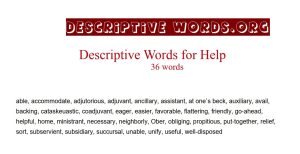
Total adjectives for the word Help: 36 words
Words are listed in alphabetical order.
able
accommodate
adjutorious
adjuvant
ancillary
assistant
at one’s beck
auxiliary
avail
backing
cataskeuastic
coadjuvant
eager
easier
favorable
flattering
friendly
go-ahead
helpful
home
ministrant
necessary
neighborly
Ober
obliging
propitious
put-together
relief
sort
subservient
subsidiary
succursal
unable
unify
useful
well-disposed
Download Help Adjectives/Descriptive Words PDF: Descriptive Words for Help PDF