Technology is the fastest-changing domain in the English language — new words emerge constantly, old ones acquire new meanings, and the vocabulary for describing digital systems, software, hardware, and innovation evolves with each product cycle. A precise technology vocabulary is essential for tech writers, journalists, marketers, and anyone who communicates about digital products and systems. This guide gives you 85 adjectives for technology, organized by quality, capability, design, and impact, with definitions and example sentences.
Words for Technical Quality and Performance
- Robust — reliable and strong; doesn’t break under load or edge cases. “Robust architecture that had survived three years of production without incident.”
- Scalable — can handle growth without proportional increase in cost or complexity. “Scalable infrastructure that added users without adding problems.”
- Responsive — reacts quickly to inputs; low latency. “Responsive interface that felt immediate rather than processed.”
- Reliable — performs consistently; high uptime and low error rate. “Reliable in the commercial sense — 99.9% uptime over twelve months.”
- Efficient — achieves results without wasting resources. “Efficient algorithm that solved in O(log n) what the previous approach took O(n²).”
- Fast — processes or responds quickly; low latency, high throughput. “Fast enough that the wait felt like the user’s own thought.”
- Stable — does not crash or behave unexpectedly. “Stable release after three months of beta testing.”
- Secure — protects against unauthorized access and attack. “Secure by design rather than by afterthought — the only kind that is actually secure.”
Words for Innovation and Design
- Innovative — introduces new ideas or methods. “Innovative approach to the problem that made the existing solutions look conservative.”
- Cutting-edge — at the forefront of technology; the latest available. “Cutting-edge in the sense of being ahead of what the market was ready to adopt.”
- Intuitive — easy to understand and use without instruction. “Intuitive interface that users understood before reading the documentation.”
- Seamless — works without visible joins or interruptions. “Seamless integration between the two platforms — the user could not tell where one ended.”
- Elegant — achieves its purpose with minimum complexity; beautiful in its efficiency. “Elegant solution that required thirty lines where the previous approach needed three hundred.”
- Streamlined — simplified and made more efficient. “Streamlined workflow that reduced the process from twelve steps to four.”
- Modular — composed of separate, interchangeable components. “Modular architecture that allowed individual components to be replaced without rebuilding.”
- Open-source — with source code freely available and modifiable. “Open-source foundation that attracted contributions from eight hundred developers.”
Words for User Experience
- User-friendly — easy for non-experts to use. “User-friendly in the sense of not requiring a manual — the highest standard.”
- Accessible — usable by people with disabilities; compliant with accessibility standards. “Accessible by design — not retrofitted for compliance but built for inclusion.”
- Immersive — creates a compelling, absorbing experience. “Immersive VR experience that required a deliberate decision to leave.”
- Frictionless — removes all unnecessary obstacles from the user’s path. “Frictionless checkout that reduced abandonment by 34%.”
- Engaging — holds attention; makes interaction feel worthwhile. “Engaging enough that users completed the onboarding flow voluntarily.”
Words for Impact and Disruption
- Disruptive — fundamentally changes an existing market or practice. “Disruptive in the Christensen sense — starting at the low end and moving up.”
- Transformative — changes something fundamentally; before and after are meaningfully different. “Transformative impact on the supply chain that eliminated three intermediaries.”
- Game-changing — alters the fundamental rules or dynamics of a situation. “Game-changing in the way of technologies that make previous approaches look quaint.”
- Pioneering — does something for the first time; leads the way. “Pioneering work that others built entire industries on.”
- Emerging — newly appearing or developing; not yet mainstream. “Emerging technology that was two years from being table stakes.”
Frequently Asked Questions
What are the best adjectives to describe technology?
For technical quality: robust, scalable, reliable, efficient, secure, and stable. For innovation: cutting-edge, innovative, pioneering, and disruptive. For design: intuitive, elegant, seamless, and streamlined. For user experience: user-friendly, frictionless, accessible, and engaging. The most important single technology adjective is ‘reliable’ — all other qualities are secondary to a system that does what it is supposed to do, consistently, without failure.
What words describe innovative technology?
Innovative technology vocabulary: cutting-edge (at the forefront), pioneering (does something first), disruptive (changes existing markets), transformative (before and after are meaningfully different), groundbreaking (breaks new ground), game-changing (alters fundamental dynamics), and emerging (newly appearing, not yet mainstream). The overused technology adjective to avoid: ‘revolutionary’ — it has been applied to so many incremental improvements that it no longer communicates genuine novelty.
What are technical adjectives for software quality?
Software quality vocabulary: robust (reliable under load and edge cases), scalable (handles growth), performant (fast and efficient), maintainable (easy to modify and update), testable (can be verified through automated testing), documented (has clear accompanying documentation), modular (composed of separate components), and secure (resistant to attack). These are the qualities that distinguish production-ready software from a working prototype.
How do tech writers describe products?
Tech writing adjectives: intuitive (easy to use without instruction), seamless (works without visible joins), responsive (reacts quickly), powerful (capable of significant tasks), flexible (adapts to different use cases), integrated (works with other systems), and comprehensive (covers all required use cases). The best tech writing avoids the clichés: ‘next-generation,’ ‘best-in-class,’ and ‘world-class’ are so overused they communicate nothing. Replace with specific, measurable claims.
What words describe artificial intelligence?
AI technology vocabulary: intelligent (performs tasks that previously required human intelligence), adaptive (learns and improves from experience), predictive (anticipates outcomes from patterns), autonomous (operates without human intervention), generative (creates new content or outputs), trained (has learned from data), and probabilistic (produces likely rather than certain answers). The most important AI adjective distinction: ‘artificial intelligence’ vs. ‘machine learning’ vs. ‘deep learning’ — each is a subset of the previous, with increasing specificity.
What are some descriptive words for Technology?
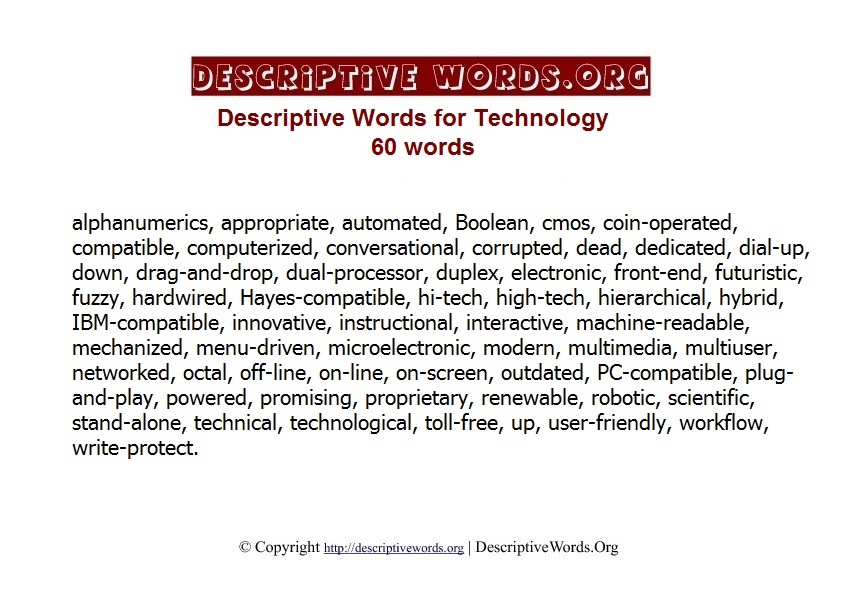
Here is a list of words that describe Technology.
Total number of Technology words and adjectives: 60 words
Technology words are listed in alphabetical order.
appropriate
automated
Boolean
cmos
coin-operated
compatible
computerized
conversational
corrupted
dead
dedicated
dial-up
down
drag-and-drop
dual-processor
duplex
electronic
front-end
futuristic
fuzzy
hardwired
Hayes-compatible
hi-tech
high-tech
hierarchical
hybrid
IBM-compatible
innovative
instructional
interactive
machine-readable
mechanized
menu-driven
microelectronic
modern
multimedia
multiuser
networked
octal
off-line
on-line
on-screen
outdated
PC-compatible
plug-and-play
powered
promising
proprietary
renewable
robotic
scientific
stand-alone
technical
technological
toll-free
up
user-friendly
workflow
write-protect
Download Technology Words PDF: Descriptive Words for Technology PDF