Chocolate is one of the most written-about foods on earth — and one of the hardest to describe precisely without retreating to generic superlatives. The vocabulary for chocolate spans flavor (bitter, sweet, fruity, earthy), texture (silky, snappy, velvety), aroma (floral, toasty, nutty), and the emotional experience of eating it. This guide gives you 75 adjectives for chocolate, organized by flavor profile, texture, type, and quality, with definitions and example sentences.
Words for Chocolate Flavor
- Bittersweet — pleasantly bitter with underlying sweetness; the balance of quality dark chocolate. “Bittersweet in the way of the best 70% bars — complex and complete.”
- Intense — deeply flavored; full concentration of chocolate. “Intensely chocolatey in a way that made a small piece feel sufficient.”
- Rich — full-bodied and deeply flavored; satisfying without being sweet. “Rich ganache that rewarded attention rather than speed.”
- Complex — has multiple distinct flavor notes that develop over time. “Complex flavor profile — fruity on entry, earthy on the finish.”
- Fruity — has notes of fruit; especially in high-percentage dark chocolate. “Fruity notes of raspberry in the single-origin Madagascar bar.”
- Earthy — has soil, tobacco, or forest floor notes; deep and ancient. “Earthy depth in the Peruvian cacao that no European process could replicate.”
- Nutty — has the toasted flavor of nuts; common in milk chocolate. “Nutty quality from the long-roasted cacao — almost hazelnut.”
- Toasty — warm, roasted flavor; caramelized and developed. “Toasty warmth from the roasting that underscored everything else.”
- Floral — has delicate flower notes; common in fine Ecuadorian chocolate. “Floral jasmine notes in the Nacional cacao — the rarest of flavors.”
- Smooth — no harsh edges; all flavors blend seamlessly. “Smooth as the best couverture — no graininess, no roughness.”
- Decadent — luxuriously indulgent; pleasurably excessive. “Decadent triple-chocolate cake that required no side dishes.”
- Velvety — smooth and rich in the mouth; the ideal chocolate mouthfeel. “Velvety ganache that needed no chewing and left no wishes.”
Words for Chocolate Texture
- Silky — frictionless and smooth on the palate. “Silky tempered chocolate that melted cleanly with no waxy residue.”
- Snappy — breaks cleanly with a sharp snap; sign of good tempering. “Snappy break — the sign of properly tempered, well-made chocolate.”
- Creamy — smooth and fat-rich in the mouth. “Creamy milk chocolate that melted at the exact right pace.”
- Crumbly — breaks apart easily; often in lower-quality chocolate. “Crumbly texture that suggested the tempering had been approximate.”
- Dense — thick and concentrated; not light or airy. “Dense brownie that was essentially chocolate in a different format.”
- Molten — liquid-centered; warm and flowing. “Molten center that made the whole dessert worth its complexity.”
- Glossy — has a shiny, reflective surface; sign of good tempering. “Glossy finish that reflected the light — the mark of the chocolatier’s skill.”
Words for Types and Quality of Chocolate
- Single-origin — from one specific growing region; traceable and distinctive. “Single-origin Ecuadorian with a flavor profile unavailable anywhere else.”
- Artisan — made by hand with skill and attention. “Artisan chocolate from a maker who knew the farmer’s name.”
- Fine — of superior quality; made with premium cacao. “Fine chocolate in the sense that wine is fine — specific and irreplaceable.”
- Couverture — high-quality chocolate with high cocoa butter content; used by professionals. “Couverture chocolate that behaved perfectly in every application.”
- Raw — minimally processed; retains more of the cacao’s natural complexity. “Raw cacao nibs — chocolate before chocolate becomes itself.”
- Aged — developed over time for greater complexity. “Aged chocolate that had deepened in flavor the way wine does.”
Frequently Asked Questions
What are the best adjectives to describe chocolate?
For flavor: rich, bittersweet, intense, complex, fruity, earthy, and toasty. For texture: silky, velvety, creamy, snappy (breaks cleanly — sign of good tempering), and molten. For quality: artisan, single-origin, fine, and couverture. The most precise chocolate descriptions combine flavor note, texture, and intensity: ‘intense, earthy dark chocolate with a silky melt and a fruity finish’ creates a specific sensory expectation.
What words describe good quality chocolate?
Quality chocolate vocabulary: single-origin (traceable cacao), fine (premium quality), artisan (made with skill), couverture (high cocoa butter content), snappy (good tempering), glossy (well-finished surface), and complex (multiple flavor layers). In chocolate evaluation, the key quality indicators are: snap (tempering), sheen (cocoa butter), aroma (cacao quality), melt rate (cocoa butter percentage), and flavor development (complexity over time on the palate).
How do you describe dark chocolate?
Dark chocolate vocabulary: bittersweet (pleasantly bitter), intense (concentrated flavor), complex (multiple flavor notes), robust (strong and full-bodied), earthy (soil, tobacco, forest floor notes), fruity (especially in high percentages), tannic (the drying, astringent quality from cacao polyphenols), and lingering (a long finish that continues after swallowing). The best dark chocolate descriptions follow the tasting note format: ‘aroma — flavor on entry — development — finish.’
How do you describe milk chocolate?
Milk chocolate vocabulary: creamy (smooth and dairy-rich), sweet (more sugar than dark), mellow (rounded, no sharp edges), nutty (from the Maillard reaction in roasting), caramel (the dairy caramelization notes), soft (melts more readily than dark), and comforting (emotionally warm and nostalgic). The best milk chocolate avoids being cloying (excessively sweet) and maintains some cocoa character despite its sweetness.
What are rare or technical words for chocolate flavor?
‘Terroir’ (the flavor of the specific place the cacao was grown), ‘typicity’ (how characteristic the flavor is of its origin), ‘tannins’ (the astringent polyphenols that give structure), ‘Maillard reaction’ (the roasting process that creates complex flavors), ‘fermentation notes’ (flavors developed during cacao fermentation — floral, fruity, or vinegary), and ‘retronasal’ (the aroma experienced after swallowing, through the back of the throat) are technical chocolate tasting vocabulary.
Chocolate may be the most universally beloved food on earth, and yet most people describe it with just two or three words: delicious, rich, sweet. The language of chocolate — when you learn it — reveals a world as complex as wine or coffee, with an enormous vocabulary for flavor, texture, aroma, and quality. Whether you are a food writer, a chocolatier, a recipe blogger, a marketer, or simply someone who wants to describe what you are tasting more precisely, this guide gives you 85 words to describe chocolate, with definitions, examples, and a guide to chocolate tasting vocabulary.
Words for Chocolate Flavor
Dark Chocolate
- Bitter — the dominant flavor note of high-percentage dark chocolate; the opposite of sweet, and the mark of quality cacao. “Pleasantly bitter in the way of strong espresso — a bitterness that rewards rather than punishes.”
- Intense — concentrated and powerful in flavor; demands attention. “An intense 85% bar that was too much for some and exactly right for others.”
- Robust — full-bodied and strong; a dark chocolate with real presence. “A robust, earthy flavor that lingered for minutes after the last bite.”
- Complex — has multiple layers of flavor that reveal themselves in sequence. “A complex bar with notes of dried fruit, tobacco, and something almost smoky.”
- Earthy — has a grounded, soil-and-forest quality reminiscent of its agricultural origins. “An earthy dark chocolate with hints of mushroom and wet leaves.”
- Fruity — contains bright, acidic, berry-like notes; common in high-quality single-origin cacao. “A surprisingly fruity 72% bar with clear notes of raspberry.”
- Astringent — drying and gripping on the palate, from tannins; like strong tea. “Slightly astringent on the finish, which is typical of high-cacao unblended bars.”
Milk and White Chocolate
- Sweet — the dominant note of milk and white chocolate; the sugar outweighs the cacao. “Sweetly familiar, like every childhood treat compressed into a single square.”
- Creamy — smooth, rich, and dairy-forward; the texture and flavor of milk or cream is prominent. “A creamy milk chocolate that melted slowly and left a clean, sweet finish.”
- Mellow — gentle, soft, and non-challenging; easy to eat without effort. “A mellow bar that suited the mood of a quiet afternoon.”
- Caramelized — contains warm, toasted, brown-sugar notes from the Maillard reaction. “A caramelized quality that came from the longer conching process.”
- Buttery — rich with the flavor of butter or butterfat; often describes white chocolate. “Buttery and sweet, with a slow melt and a vanilla finish.”
- Vanilla-scented — the characteristic aroma note of white and many milk chocolates. “The vanilla-scented sweetness was unmistakable from the moment the wrapper opened.”
Words for Chocolate Texture
- Silky — smooth and frictionless on the tongue; the ideal texture of well-tempered chocolate. “A silky texture that coated the palate completely before melting.”
- Velvety — smooth and rich; slightly heavier than silky, with more depth. “A velvety ganache that dissolved rather than melted.”
- Smooth — free from grit or grain; the most basic positive texture descriptor. “Smooth and even from the first taste to the last.”
- Crisp — breaks cleanly; the snap of well-tempered chocolate is a quality indicator. “A crisp snap that is the first sign of properly made chocolate.”
- Melt-in-the-mouth — dissolves instantly on the tongue with little chewing required. “Melt-in-the-mouth texture that justified every penny of the price.”
- Unctuous — richly smooth in a way that is almost excessive; luxuriously oily. “An unctuous truffle that left traces of richness long after it was gone.”
- Waxy — not enough cocoa butter; a negative texture descriptor. “The cheap bar had a waxy mouthfeel that no amount of sweetness could disguise.”
- Chalky — powdery and dry; another negative texture indicator. “Chalky and dull — clearly made with cocoa powder rather than real cacao.”
Words for Chocolate Aroma
- Fragrant — pleasant and distinctive in smell; good chocolate is aromatic before it is tasted. “The fragrant warmth of a chocolate shop is a form of marketing that costs nothing.”
- Floral — contains light, flower-like aromatic notes; found in some fine single-origin chocolates. “A floral top note — almost like rose — that surprised and delighted.”
- Roasted — the warm, deep aroma of properly roasted cacao beans. “A deeply roasted aroma, as rich and welcoming as a good coffee.”
- Heady — strong and slightly intoxicating in its richness and intensity. “The heady smell of dark chocolate in the tempering room.”
Words for the Overall Chocolate Experience
- Decadent — rich, indulgent, and pleasurably excessive. “A decadent dessert that required no apology.”
- Luscious — richly pleasing; smooth and abundant. “A luscious mousse that felt like edible luxury.”
- Indulgent — allowing oneself a pleasure beyond the everyday; a treat rather than a staple. “An indulgent box of truffles that was finished in one sitting without guilt.”
- Exquisite — of exceptional refinement and quality; the vocabulary of artisan chocolate. “An exquisite single-origin bar from a small producer in Madagascar.”
- Satisfying — meets a deep craving fully; gives you exactly what you needed. “Deeply satisfying in the way that nothing else quite replicates.”
- Comforting — warm, familiar, and emotionally soothing. “Comforting in the way of a childhood smell — uncomplicated and completely reliable.”
How to Describe Chocolate Like a Professional
Professional chocolate tasters evaluate five things: appearance (color, shine, bloom), snap (the sound and feel of the break), aroma (before and after breaking), mouthfeel (how it melts), and flavor (the first note, the middle, and the finish). A good dark chocolate should snap sharply, melt slowly, and have a finish that lasts 30-60 seconds. If the flavor disappears immediately, the quality is low; if it evolves and lingers, it is likely exceptional.
Frequently Asked Questions
What are the best words to describe chocolate?
For dark chocolate: bitter, intense, complex, robust, and earthy. For milk chocolate: sweet, creamy, smooth, and mellow. For white chocolate: buttery, sweet, and vanilla-scented. For artisan chocolate: nuanced, single-origin, fruity, and layered.
What is a sophisticated word for delicious chocolate?
‘Decadent’ is the most widely used elevated word. ‘Luscious’ suggests richness. ‘Exquisite’ implies refinement. ‘Ambrosial’ is rare and beautiful. For complexity: ‘nuanced’ and ‘layered’ are the vocabulary of serious chocolate criticism.
How do chocolatiers describe chocolate?
Professional tasters use: terroir, single-origin, tannins, mouthfeel, finish, and bloom. Flavor notes include fruity, floral, earthy, woody, nutty, and tobacco — a vocabulary borrowed directly from wine tasting.
What words describe the texture of chocolate?
Good texture: silky, velvety, creamy, crisp (snap), and melt-in-the-mouth. Poor texture: chalky, waxy, and gritty. The best chocolate has a clean snap and a long melt.
What are words to describe the taste of dark chocolate?
Dark chocolate: bitter, intense, robust, complex, earthy, smoky, fruity, tannic, and astringent. Single-origin bars may show specific notes: Madagascar (smoky, fruity), Ecuador (red fruit), Ghana (mellow, earthy).
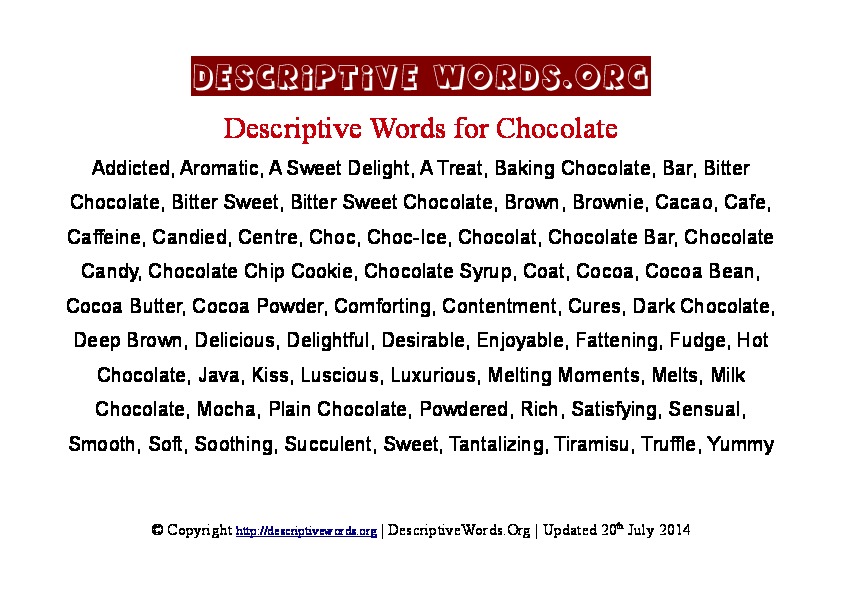
What are some descriptive words for Chocolate ?
Here is a list of words that describe the chocolate.
Total number of chocolate words and adjectives: 85 words
Chocolate words are listed in alphabetical order.
aromatic,
a sweet delight,
a treat,
baking chocolate,
bar,
bitter chocolate,
bitter sweet,
bitter sweet chocolate,
brown,
brownie,
cacao,
cafe,
caffeine,
candied,
centre,
choc,
choc-ice,
chocolat,
chocolate bar,
chocolate candy,
chocolate chip cookie,
chocolate syrup,
coat,
cocoa,
cocoa bean,
cocoa butter,
cocoa powder,
comforting,
contentment,
cures,
dark chocolate,
deep brown,
delicious,
delightful,
desirable,
enjoyable,
fattening,
fudge,
hot chocolate,
java,
kiss,
luscious,
luxurious,
melting moments,
melts,
milk chocolate,
mocha,
plain chocolate,
powdered,
rich,
satisfying,
sensual,
smooth,
soft,
soothing,
succulent,
sweet,
tantalizing,
tiramisu,
truffle,
yummy .
Download chocolate Words PDF: Descriptive Words for chocolate PDF